Blog Posts

What Does a Good Floor Waxing Schedule Look Like?

A commercial floor that gets waxed on the right schedule lasts 20 to 30 years. The same floor on the wrong schedule (or no schedule) gets stripped to bare tile and replaced in 8 to 12. The difference is a few hundred dollars a quarter in maintenance versus tens of thousands in floor replacement. This is what a good floor waxing schedule actually looks like for commercial facilities on Long Island.

Why floor waxing matters

Floor wax (or, more accurately, floor finish) is a sacrificial layer. It takes the abuse of foot traffic, dirt, salt, and cleaning chemicals so the floor underneath does not. When the wax is intact, the floor looks great and the tile or plank or sealed concrete underneath is protected. When the wax wears through, every step is one more scratch on the actual floor. By the time the wear shows on the surface, the damage is structural.

Regular waxing on a defined schedule keeps the wax intact, the shine consistent, and the floor itself preserved. This is one of those silent maintenance tasks: when it is done right, no one notices, and the floor lasts decades.

What “schedule” actually means

“Floor waxing schedule” actually covers four different jobs that happen on different cadences. Confusing them is how facilities end up with patchy floors and surprised invoices.

  • Daily maintenance. Dust mopping and damp mopping with a neutral pH cleaner. This is part of nightly janitorial service and is what keeps the wax from getting trapped under abrasive grit. Skip it and the wax wears 3x faster.
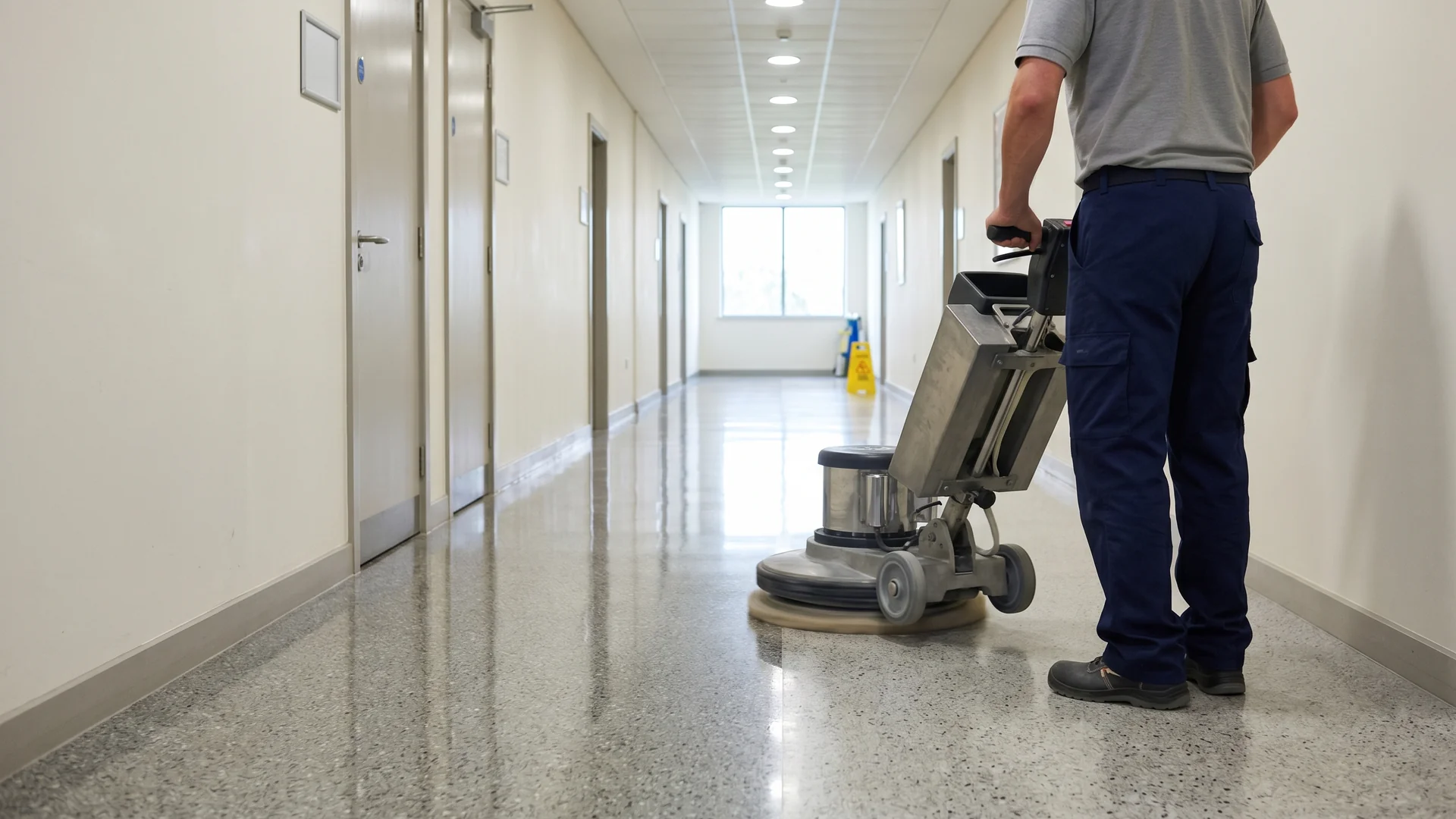
  • Burnishing or buffing. Done weekly or monthly. A high-speed burnisher passes over the wax to re-melt and re-level the surface, restoring the gloss. Burnishing extends the life of a wax application by months. Cheap; high impact.
  • Scrub and recoat. Done quarterly to semi-annually. The top layer of wax is gently scrubbed off, and one or two fresh coats are applied. Restores depth and gloss without going down to bare floor. The maintenance cycle most commercial facilities should be running.
  • Strip and wax. Done annually to every two years for most commercial floors. Every coat of wax is stripped off down to the floor itself, the floor is cleaned and dried, and four to six fresh coats of finish are applied. The reset that the scrub-and-recoat cycle stretches between.

What schedule does my floor need?

The right schedule depends on traffic volume, type of floor, and how it is used. Some general guidance for commercial Long Island facilities:

Low to moderate traffic (small offices, professional offices, dental, low-traffic retail)

  • Daily dust and damp mop (nightly janitorial)
  • Burnish monthly
  • Scrub and recoat semi-annually
  • Full strip and wax annually

Moderate to high traffic (medical waiting rooms, multi-tenant lobbies, mid-sized retail, restaurants front-of-house)

  • Daily dust and damp mop (nightly janitorial)
  • Burnish twice a month
  • Scrub and recoat quarterly
  • Full strip and wax annually

Very high traffic (schools, supermarkets, gym lobbies, busy restaurant kitchens, public buildings)

  • Daily dust and damp mop, often multiple times per day
  • Burnish weekly
  • Scrub and recoat every 6 to 8 weeks
  • Full strip and wax twice a year, sometimes more

Specialty floors (terrazzo, polished concrete, sealed natural stone)

These do not get traditional wax. They get a different maintenance program: routine cleaning with stone-safe chemistry, periodic re-honing or re-polishing, and re-sealing every two to five years depending on traffic. We cover terrazzo and sealed stone in our floor refinishing service.

Signs you are on the wrong schedule

Three signs your floor maintenance is off:

  • Visible traffic patterns. The walking lanes look duller than the edges. This means burnishing has fallen behind. Catch it now and a scrub-and-recoat will restore it. Wait six months and you need a full strip and wax.
  • Black scuff marks that will not come up. Scuffs that resist normal scrubbing are sitting in worn-through wax. The floor is no longer protected. Schedule a strip and wax in the next 30 days.
  • The floor feels gritty or sticky underfoot. Almost always a chemistry problem: cleaning solutions are leaving residue, or the wrong floor pad is getting used. Worth investigating before it becomes a wear problem.

Common mistakes that wreck a floor waxing schedule

  • Skipping daily mopping. Grit is the #1 enemy of wax. One missed nightly clean accelerates wear noticeably.
  • Using the wrong chemistry. High-pH cleaners (often sold as “industrial strength”) strip wax slowly with every use. Always use neutral-pH cleaner on waxed floors.
  • Burnishing infrequently. Skipping burnishing and going straight to scrub-and-recoat is more expensive and produces a less consistent finish.
  • Stripping too aggressively. Stripping is hard on the floor underneath. Doing it more than once or twice a year shortens the floor’s life. The right answer is more frequent scrub-and-recoats, not more frequent stripping.
  • Cheap wax. Wax is one of the few places where the budget product is meaningfully worse. Commercial-grade finish (18% to 25% solids) lasts twice as long as the cheap stuff.

Building your schedule with a commercial cleaner

A good commercial cleaning vendor will document your floor maintenance schedule the same way they document everything else: in writing, by zone, with clear cadence. The schedule should specify which weeks the burnish happens, which months the scrub-and-recoat happens, and which week of the year the strip-and-wax happens.

Most facilities benefit from spreading scrub-and-recoats across the calendar so the floor crew is not slammed in one season. Strip-and-wax is typically scheduled during slow business periods (late summer for office, holiday breaks for schools, mid-week overnight for restaurants).

Frequently Asked Questions

How long does floor wax actually last?

A commercial-grade finish, on a moderately trafficked floor, with proper daily maintenance and monthly burnishing, will last 8 to 14 months between strip-and-waxes. Add quarterly scrub-and-recoats and you can stretch this to 18 to 24 months on lower-traffic floors.

What is the difference between waxing and refinishing?

Waxing applies a sacrificial coating of finish on top of an intact floor. Refinishing typically refers to actual restoration of the floor itself (sanding hardwood, re-honing terrazzo, re-sealing stone). Wax is for VCT, vinyl plank, sealed concrete, and certain ceramic tile. Refinishing is for hardwood, terrazzo, marble, and other natural surfaces.

Can I just have my night crew apply wax?

For a routine touch-up coat, sometimes yes. For scrub-and-recoat or full strip-and-wax, no. These jobs require dedicated equipment (auto-scrubbers, high-speed burnishers, high-output ventilation) and trained operators. The labor and equipment cost of doing it wrong is higher than hiring a specialty crew.

How long does the floor have to stay closed?

For burnishing, no closure is required (often done overnight). For scrub-and-recoat, the floor needs 2 to 4 hours of dry time. For full strip-and-wax, expect 6 to 12 hours of closure depending on the number of coats. Most commercial strip-and-waxes are done overnight on a Friday so the floor is fully cured by Monday morning.

Do you handle floor waxing for restaurants and food service?

Yes. Restaurant floor waxing is one of our specialty areas. Kitchens get an oil-and-grease-resistant finish; front-of-house gets a higher-gloss finish. Both are scheduled for after closing so you do not lose service hours. See our restaurant cleaning service.

Need a floor waxing schedule built for your facility?

Request a free site walk from E & J Cleaning. We will look at your floors, recommend the right schedule, and put it in writing with fixed pricing. See our full floor waxing service or call 1-877-443-2635.

How to Choose a Commercial Cleaning Company on Long Island

Hiring the wrong commercial cleaning company is expensive in two directions. You pay for a service you do not actually receive, and you spend internal time chasing the company about why the trash was missed again. The good news: most of the bad outcomes are predictable from the way the company sells. This guide is what to ask, what to look at, and what to walk away from when hiring a commercial cleaner on Long Island.

Step 1: Get clear on what you actually need before you call anyone

Before you contact a single vendor, write down a one-page summary of your facility: total square footage, number of restrooms, type of flooring, hours of operation, days of the week you need cleaning, any specialty zones (medical exam rooms, restaurant kitchen, server room, retail floor), and any rules from your landlord or insurance carrier. This gives every vendor the same starting point and makes proposals comparable.

If you do not know any of this, do not worry. A strong commercial cleaner will walk your facility and document it for you. But coming to the conversation with a draft of what you need keeps you in control of the scope.

Step 2: Demand a written, zone-by-zone scope

The single biggest predictor of long-term satisfaction is whether the cleaning scope is documented. A scope-by-zone document lists every space in your facility and every task that gets performed there at every frequency. Lobby: dust desks weekly, vacuum nightly, polish glass twice weekly, empty trash nightly, restock paper Monday morning. That level of specificity.

If a vendor is unwilling or unable to document the scope this way, walk away. Vague proposals (general office cleaning at a fixed monthly rate) are how you end up arguing about whether the conference room was supposed to get vacuumed.

Step 3: Verify insurance, bonding, and W-2 employment status

Three documents to ask for in writing: a current certificate of liability insurance, a current janitorial bond, and confirmation that field staff are W-2 employees rather than 1099 subcontractors. Each protects you differently.

Liability insurance covers damage to your property. Bonding covers theft. W-2 employment matters because subcontracted labor varies in quality, training, and accountability; a company that runs everyone as W-2 has a vested interest in retention and supervision. If the company hesitates to provide any of these documents, that is the answer.

For larger commercial leases and multi-tenant properties, your landlord may also require certificates of insurance naming them as additional insured. Make sure your cleaner can do this.

Step 4: Ask how supervision works

The crew you meet on the walk-through is not necessarily the crew that cleans your facility every night. The question that matters is: how does the company keep service consistent across visits? Look for specific answers, not generic ones.

Strong answers: a named account manager who walks the facility monthly, supervisor walk-throughs scheduled at 30 and 60 days for new accounts, written checklists left at the site after each visit, a defined escalation path when something is missed, and a backup crew for vacations and sick days so coverage never lapses.

Weak answers: “we have a great team” with no specifics. “We do quality control” with no defined cadence. “Just call me if there’s a problem” — fine, but what about the problems you do not catch?

Step 5: Look at how they handle the walk-through

The walk-through is when you learn the most about a vendor. Watch for whether the salesperson asks questions about your operation or whether they are just measuring square feet to plug into a formula. The right vendor asks who works in the building, what time the last person leaves, what past cleaners have missed, what the landlord cares about, what your tolerance is for after-hours noise, what chemicals you cannot have on premise, what zones are higher-priority than others.

If the walk-through feels like a measure-and-quote in twenty minutes, the resulting service is going to feel the same way. Take your time. The walk-through is also when you decide whether you want this person and their crew in your building every night.

Step 6: Compare proposals on like-for-like, not lowest price

Three commercial cleaning proposals on the same facility will often span a 2x or 3x range. The lowest is almost never the best. The reason cheap proposals are cheap is because the scope is thin or the labor is misclassified.

To compare apples to apples, line up the scope documents side by side. Every task, every frequency, every zone. If one proposal includes nightly restroom restocking and another only includes weekly, that is a meaningful difference. If one includes monthly floor care and another does not, that is even bigger.

Once the scope is normalized, then look at price. Often the middle proposal is the right one — enough scope to cover what you actually need, priced for a company that pays its labor properly.

Step 7: Ask for references in your industry

A medical office’s cleaning needs are completely different from an auto dealership’s. Ask each vendor for two or three references in your specific industry, and call them. The questions to ask: how long they have been a client, whether the same crew has stayed consistent, how problems get resolved, what they would change about the service if they could.

If a vendor cannot produce references in your industry, they may still be capable, but you are now their training run. Make sure you understand what that means for the first 90 days.

Step 8: Read the contract before you sign

Three contract terms that matter most:

  • Term length and termination. Month-to-month after a 90-day onboarding window is the modern standard. If a vendor wants a 3-year contract, ask why and what your termination rights look like.
  • Price escalation. Annual increases tied to wage cost are normal and reasonable. Open-ended discretionary increases are not.
  • Specialty service pricing. Floor care, carpet cleaning, window cleaning, and emergency response should be priced separately and disclosed up front. Otherwise you discover the pricing the first time something happens.

What to walk away from

A few red flags that should end the conversation early:

  • Refusal to provide insurance certificates or bonding.
  • Pricing without a written scope.
  • Pressure to sign before you have walked the facility together.
  • Vague answers about how field staff are paid or supervised.
  • No named account manager or single point of contact.
  • Inability to handle floor care, carpet, windows, and emergencies on the same contract (vendor sprawl is one of the largest hidden costs in facility management).

Frequently Asked Questions

How much should commercial cleaning cost on Long Island?

Pricing varies widely with facility size, industry, and frequency. As a rough range, nightly office cleaning for a 5,000 sq ft office in Suffolk County is typically $1,500 to $3,500 per month depending on scope. Medical and food service run higher because of additional protocols. Get three written proposals on the same scope before you anchor on a number.

Should I hire a national franchise or a local cleaner?

For most Long Island businesses, a local family-owned company will deliver better service consistency. Franchises tend to have higher staff turnover, more layers between you and the people doing the work, and less flexibility on scope changes. Locals tend to have direct accountability, longer-tenured staff, and the ability to tailor scope to your facility.

What is the right cleaning frequency?

Most commercial offices need nightly cleaning Monday through Friday. Medical offices, restaurants, and high-traffic retail often need daily. Smaller offices and specialty spaces sometimes thrive on three-night-a-week or Monday-Wednesday-Friday cadences. The walk-through is where this gets decided.

How long is a typical contract?

Industry standard is month-to-month after a 90-day onboarding period. Longer terms are sometimes appropriate for specialty service contracts (long-term floor care programs, supply fulfillment) but should not be the default for nightly cleaning.

Ready for a free site walk?

If you are evaluating commercial cleaning vendors on Long Island, request a free site walk from E & J Cleaning. We will visit, listen, document a written scope, and propose a fixed monthly price within a week. See our full commercial cleaning services or call 1-877-443-2635.

What Does It Mean to Go Green? A Guide to Green Cleaning

What Does It Mean to Go Green? A Guide to Green Cleaning

E & J Cleaning Services · Cleaning Information

Open office window with natural light, representing fresh air and low-VOC green cleaning

The phrase “green cleaning” gets used by everyone from big-box product makers to local cleaning companies, and it doesn’t mean the same thing in every mouth. If you are trying to evaluate whether a cleaning program is actually green or just marketed that way, this guide walks through what the term really means, why it matters for the health of the people in your building, and how to separate a real green cleaning program from a sticker on a bottle.

The short version: green cleaning is a holistic approach that covers the products being used, how those products are manufactured and packaged, the equipment and methods that apply them, and the training of the people doing the work. Swapping one harsh chemical for an “eco” version of the same chemical is not green cleaning. It is marketing.

Defining green cleaning

Wikipedia frames green cleaning as a move away from toxic, chemically reactive products toward safer, eco-friendly solutions. Conventional products can emit volatile organic compounds (VOCs) that cause respiratory problems, skin reactions, and other health issues. Green cleaning also covers how products are manufactured, packaged, and distributed. A biodegradable product made in an environmentally responsible factory is green. A biodegradable product shipped in wasteful packaging from a factory with a poor environmental record is less green than it appears.

The U.S. Environmental Protection Agency sets exposure limits on many common cleaning chemicals, but those limits reduce harm; they do not eliminate it. The only way to know what is in a product is to read the small print on the label. Certifications from third parties like Green Seal, UL ECOLOGO, and EPA Safer Choice give a useful shortcut because independent evaluators have already checked what is inside. Relying on a product’s own “eco” marketing without third-party certification is unreliable.

Why green cleaning matters for the health of a building

The most direct reason to go green is indoor air quality. According to the EPA, indoor air can contain pollutant levels two to more than 100 times higher than outdoor air. A large share of that pollution is VOC emissions from home and commercial cleaning products, air fresheners, and furnishings. Once a window is opened, those compounds do not just vanish; they continue to outgas from soft surfaces, finishes, and stored products.

Exposure to these compounds is not theoretical. Research on formaldehyde, benzene, and related solvents has produced enough evidence to justify legal exposure limits, though these substances are still present in consumer goods within those limits. A 1999 New Scientist study found that frequent aerosol and air-freshener use in homes tracked with measurable health effects: 25 percent more headaches and 19 percent higher odds of depression in mothers, and in infants under six months, 30 percent more ear infections and a 22 percent higher diarrhea risk. These effects are why “everything smells clean” is not a reliable signal that a building is actually cleaner.

What a real green cleaning program includes

A green cleaning program is more than a product swap. At E & J Cleaning Services, our green program covers the following:

Certified products, not “eco-looking” products. We use third-party-certified cleaning chemistry: Green Seal, UL ECOLOGO, or EPA Safer Choice. These certifications are independent checks on what is actually in the bottle.

Concentrates over ready-to-use. Concentrated products, diluted on site, reduce packaging waste and transportation emissions compared to pre-mixed ready-to-use products. Dilution protocols ensure we use the right concentration, not a wasteful overdose.

Microfiber systems. Microfiber cloths and mops capture dust and soil mechanically, which reduces the amount of chemical needed to clean a surface. When used dry, microfiber also picks up fine particulate that traditional cotton products push around without capturing.

HEPA-filtered vacuums. HEPA filtration traps particles down to 0.3 microns at 99.97 percent efficiency. That keeps fine dust, allergens, and mold spores in the vacuum bag instead of recirculating into the air for people to breathe.

Entryway matting. Effective entryway mats capture 80 to 90 percent of the soil and moisture that would otherwise track into a building. A mat of at least 12 to 15 feet of walk length is the single highest-leverage “cleaning” investment a building can make, because dirt that never enters doesn’t need to be cleaned up.

Touch-free fixtures and fulfillment. Automatic faucets, flush valves, and soap dispensers reduce water use, cross-contamination, and product waste. Bundled with a consistent paper and soap fulfillment program, they also keep restrooms stocked without over-ordering.

Trained crews, not just trained equipment. The most certified product in the world fails if a crew uses it wrong. Our crews are trained on dilution, dwell time, surface compatibility, and safe disposal for every green product we carry.

The practical benefits of going green

Properties that switch to a well-designed green cleaning program see benefits across several dimensions:

  • Improved productivity and morale among building occupants. Fewer headaches, fewer respiratory complaints, less midafternoon fatigue.
  • Healthier cleaning staff. The people swinging mops and spraying chemistry all day are the most exposed to what a building uses. Green programs protect them first.
  • Fewer sick days for both staff and occupants, driven by better indoor air and lower microbial load.
  • Community recognition and brand signal. Tenants, employees, and customers who care about sustainability notice.
  • Lower liability exposure from worker safety issues tied to chemical handling.
  • Direct points toward LEED certification from the U.S. Green Building Council. For properties pursuing or maintaining LEED, a documented green cleaning program counts toward specific credits.

How to evaluate whether a cleaning program is actually green

If you are hiring a cleaning company or evaluating your current vendor, here are the questions to ask:

  1. Which third-party certifications do your products carry? Green Seal, UL ECOLOGO, and EPA Safer Choice are the credible ones. “Eco-friendly” on the label without certification is marketing.
  2. Are your crews trained on dilution and dwell time? A product used at the wrong concentration is either wasted money or a health risk.
  3. Do you use HEPA-filtered vacuums? If the vacuum blows fine particulate back into the air, that room is no cleaner than when you started.
  4. Do you use microfiber systems? Microfiber captures soil mechanically, which reduces the amount of chemistry required.
  5. Can you document your program for LEED or a sustainability report? A real program produces paperwork. Marketing produces slogans.

E & J Cleaning Services builds green cleaning programs for Long Island businesses, medical offices, schools, and homes. If you want to understand what a real program would look like for your facility, visit our Green Cleaning service page or call 1-877-443-2635 for a free consultation.

Frequently Asked Questions

What does “green cleaning” actually mean?
Green cleaning uses EPA Safer Choice or Green Seal certified products, microfiber instead of disposable wipes, HEPA-filtered vacuums, and reduced packaging waste. It maintains hygiene effectiveness while reducing chemical exposure, indoor air pollution, and environmental impact. “Green” should be third-party certified, not just marketing language.
Are green cleaning products as effective as conventional ones?
Yes when used correctly. EPA-registered green disinfectants kill 99.9 percent of pathogens including MRSA, norovirus, and influenza when applied with correct dwell time. The key is training: poorly used green products underperform, just like poorly used conventional ones.
How do I know if a product is really green versus greenwashing?
Look for third-party certification logos: EPA Safer Choice, Green Seal, EcoLogo, or USDA BioPreferred. A product that says “natural” or “eco-friendly” without certification is likely marketing language. Real green products show certification numbers on packaging and have data sheets you can verify.
Will switching to green cleaning cost more?
Per-clean costs are usually comparable. Concentrated green products diluted on-site are competitively priced. The bigger cost difference is downstream: lower sick-day rates, fewer chemical sensitivity complaints, better LEED scores, and reduced disposable supply costs over time.
Is green cleaning safer for children, pets, and patients?
Significantly safer. Conventional disinfectants release VOCs that irritate respiratory systems and linger for hours. Green-certified products have lower VOC emissions, no harsh fragrances, and no skin/eye irritation from cleaning residues. Critical for daycares, schools, medical offices, and households with chemical sensitivities.

How to Choose the Best Commercial Cleaning Services in Suffolk County, NY

Best Commercial Cleaning Services in Suffolk County, NY Long Island

If you own or manage a business in Nassau or Suffolk County, NY, you know how important it is to keep your premises clean and sanitary. A clean work environment not only boosts your productivity and reputation, but also protects your health and safety.

But how do you find the best commercial cleaning services in your area? With so many options available, it can be hard to decide which one to trust with your cleaning needs.

That’s why we’ve put together this guide to answer the question “how to you choose the best commercial cleaning services in Suffolk County, NY?”. Here are some factors to consider when looking for a reliable and professional cleaning company.

Experience and Reputation

One of the first things to look for in a commercial cleaning company is their experience and reputation. How long have they been in business? What kind of clients do they serve? What do their previous and current customers say about them?

You want to hire a company that has a proven track record of delivering high-quality cleaning services to businesses like yours. Also check their website, social media pages, online reviews, and testimonials to get a sense of their reputation and credibility.

You can also ask them for references and contact some of their clients to get their feedback. A reputable company will be happy to provide you with this information and show you examples of their work.

Services and Equipment

Another factor to consider is the range of services and equipment that the commercial cleaning company offers. Depending on your business type and size, you may have different cleaning needs and preferences.

For example, you may need regular janitorial services, such as dusting, vacuuming, sanitizing, and trash removal. Or you may need specialized services, such as carpet cleaning, window washing, floor waxing, or disinfection.

You also want to make sure that the company has the right equipment and supplies to handle your cleaning tasks effectively and efficiently. For instance, they should have professional-grade vacuums, mops, brushes, cleaners, disinfectants, and protective gear.

You can ask the company for a list of their services and equipment and see if they match your expectations and requirements.

Availability and Flexibility

A third factor to consider is the availability and flexibility of the commercial cleaning company. How often do you need their services? What time of day or night do you prefer them to come? How easy is it to schedule or reschedule an appointment?

You want to hire a company that can accommodate your schedule and frequency needs without compromising on quality or reliability. Look for a company that can adjust to your changing needs and preferences as your business grows or faces challenges.

You can ask the company about their availability and flexibility and see if they can offer you a customized cleaning plan that suits your business goals and budget.

Pricing and Guarantee

A final factor to consider is the pricing and guarantee of the commercial cleaning company. How much do they charge for their services? What are the payment terms and methods? What kind of guarantee do they offer for their work?

You want to hire a company that offers fair and transparent pricing for their services without any hidden fees or charges. Ensure the company stands behind their work and offers a satisfaction guarantee or a refund policy in case you are not happy with the results.

You can ask the company for a free quote or estimate for their services and compare it with other options in your area. You can also ask them about their guarantee policy and see if they are confident enough to back up their claims.

Why Choose Us?

If you are looking for the best commercial cleaning services in Suffolk County, NY, look no further than E & J Cleaning Services. We are a locally owned and operated company that has been serving businesses in Suffolk County since 2005.

We offer a wide range of commercial cleaning services, including:

We use state-of-the-art equipment and eco-friendly products to ensure that your premises are clean, safe, and healthy. We also have a team of trained, licensed, insured, and background-checked cleaners who are courteous, professional, and detail-oriented.

We are available 24/7 to meet your schedule and frequency needs. We also offer flexible and affordable pricing plans that fit your budget. And we guarantee your satisfaction or your money back.

Don’t settle for anything less than the best when it comes to your commercial cleaning needs. Contact us today at 1-844-2635 or visit our website at www.eandjcleaning.com to get a free quote or schedule a service.

E & J Cleaning Services – The Best Commercial Cleaning Services in Suffolk County, NY

Frequently Asked Questions:

What are the training and qualifications of the cleaning staff?

At E & J Cleaning Services, we prioritize the expertise and professionalism of our cleaning staff. Each member of our team undergoes comprehensive training to ensure they are equipped with the necessary skills and knowledge to deliver exceptional cleaning services. We also conduct thorough background checks and require appropriate licensing and insurance to guarantee the reliability and trustworthiness of our cleaners.

Can you customize the Cleaning Service to my specific needs with unique cleaning requirements and a customer cleaning frequency?

We understand that every business has unique cleaning needs, and we’re committed to providing tailored solutions that meet those requirements. Our team works closely with clients to understand their specific preferences and priorities, allowing us to customize our services accordingly. Whether you need specialized cleaning tasks, adjustments to cleaning frequencies, or accommodations for particular cleaning products, we’re dedicated to accommodating your individual business needs.

How do you respond to Emergency Situations? Is there any service to quickly respond to urgent cleaning needs like spills, floods, or other unexpected incidents?

Emergencies can arise unexpectedly, and we’re prepared to respond promptly to address urgent cleaning needs. With our 24/7 availability, you can rely on us to mobilize a cleaning team quickly in the event of spills, floods, or other unforeseen incidents. Our established protocols ensure efficient handling of emergency situations, allowing us to mitigate risks and restore cleanliness and safety to your premises without delay.

This entry was posted in Information and tagged Best Commercial Cleaning Companies in NYBest Commercial Cleaning Companies in Suffolk CountyCommercial Cleaning Suffolk County New YorkLong Island Commercial Cleaning CompaniesOffice Cleaning Long Island NYOffice Cleaning Suffolk CountySuffolk County Commercial Cleaning on  by eandjcleaning.

Frequently Asked Questions

What should I look for in a commercial cleaning company on Long Island?
W-2 employees not subcontractors, full insurance and bonding documentation, background-checked crews, written scope of work in plain English, consistent crew assignments, active account management, transparent pricing, and references from facilities similar to yours. Skip anyone who cannot show all of this.
How do I vet a cleaning service before signing a contract?
Request a free site walk where they assess your facility before quoting. Ask for COI naming your business as additionally insured. Verify the W-2 vs subcontractor claim through their payroll documentation. Call 2 to 3 references from facilities similar in size to yours. Ask for a written scope and pricing before commitment.
What questions should I ask cleaning companies during the bid process?
How long have you been in Long Island? W-2 employees or subcontractors? What is your background check process? Insurance coverage limits? How do you handle staff turnover on my account? What if I am not happy after 30 days? Can I see your written scope of work and supply list?
What is a reasonable price for commercial cleaning in Suffolk County?
$0.08 to $0.30 per square foot per month for nightly cleaning depending on facility type and frequency. A 5,000 sq ft office runs $1,500 to $2,500 monthly typical range. Specialty work (floor care, carpet, windows) is priced per job. Very low pricing often signals subcontracted labor and quality risk.
Should I choose a franchise or a local cleaner?
Local family-owned companies typically offer better consistency (less crew rotation), faster response, and direct owner accountability. Franchises offer broader geographic coverage. For a single-facility Long Island business, local nearly always wins for service quality. For multi-state operations, franchise may make sense.

Why your business needs a professional commercial cleaning company

“We have someone who handles the cleaning.” That sentence describes how most Long Island businesses manage facility maintenance. Sometimes it is a maintenance person picking up cleaning as a side duty. Sometimes it is a part-time janitor hired directly. Sometimes it is office staff splitting the work. The result is usually inconsistent quality, hidden costs, and missed opportunities. Here is why hiring a professional commercial cleaning company changes that.

The Real Cost of In-House Cleaning

Businesses that compare “professional cleaning service cost” versus “what we pay our cleaning person” almost always miscalculate. The in-house cost is much higher than the visible payroll line suggests. Here is what gets missed.

  • Payroll taxes and workers comp. Add 15 to 25 percent to the hourly rate.
  • Training time. First 30 days of any new cleaning hire is essentially paid training.
  • Equipment purchase and depreciation. Professional vacuums, floor machines, and chemical dispensing equipment cost thousands and need maintenance.
  • Supply inventory management. Someone orders, stores, and tracks chemical and paper inventory.
  • Coverage during sick days and vacations. Either coverage gaps or expensive backup labor.
  • Management time. Whoever supervises the cleaner spends hours per month on HR, scheduling, and quality issues.
  • Turnover replacement. Cleaning role turnover is high. Each replacement costs recruiting, hiring, and training time.

Add it all up and most in-house cleaning operations cost 40 to 80 percent more than their owners realize. A professional cleaning service that looks expensive on a per-month basis often saves money once the full comparison is made.

What a Professional Commercial Cleaning Company Actually Provides

The word “professional” gets used loosely. Here is what it actually means in commercial cleaning:

Trained W-2 employees, not subcontractors

This is the most important difference. W-2 employees are screened, trained, and stay on your account. Subcontracted crews rotate, do not know your space, and do not carry your standards. The cheapest commercial cleaning quotes nearly always come from subcontractor-heavy operations. The pattern of inconsistent service follows from that staffing model.

Written scope of work

A professional service documents in writing what gets cleaned, when, how, and to what standard. This is what makes service consistent and accountable. Verbal-only arrangements drift. Written scope holds.

Professional equipment

HEPA-filtered vacuums, microfiber systems, color-coded cloths to prevent cross-contamination, auto-scrubbers for large floors, electrostatic sprayers for fast disinfection coverage, and floor machines for strip-and-wax cycles. This equipment costs thousands of dollars but produces measurably better results.

Insurance and bonding

General liability typically $2M to $5M. Employee bonding. Workers compensation. Certificate of insurance documenting your business as additionally insured. If something goes wrong, the coverage protects you. Without it, you are exposed.

Active account management

An account manager who knows your facility, responds to issues quickly, and proactively recommends improvements. This is the difference between a service vendor and a service partner.

How Quickly You See Results

The transition from in-house or subpar cleaning to professional service produces measurable changes within predictable timelines.

  • Week 1: Visible improvements in restroom cleanliness, supply restocking, and entry zone appearance.
  • Month 1: Reduced facility complaints. Better consistency. Supply emergencies disappear.
  • Month 3: Management time freed up. Sick day rate begins to drop. Floor and finish condition starts improving.
  • Month 6: Customer perception scores measurably better. Employee retention improves. Compliance documentation in place.
  • Year 1: Total facility cost (cleaning plus avoided downstream costs) clearly lower than the previous arrangement.

The ROI of Professional Cleaning

The cleaning service line item on your budget is not the whole picture. Professional cleaning produces measurable ROI through:

  • Avoided in-house labor cost (including hidden costs)
  • Reduced absenteeism saves productive hours
  • Extended floor and equipment life cuts replacement budget
  • Fewer emergency cleanups means lower variability in facility costs
  • Lower supply waste through better inventory management
  • Management time recovery for revenue-generating work
  • Reduced insurance claims for slip and fall, air quality, pest issues

The typical payback period for switching from in-house or subpar cleaning to professional service is 6 to 18 months. After that, the service is a net savings every month it runs.

How to Choose the Right Partner

Not all commercial cleaning companies are equal. Use this checklist when evaluating:

  • Does the company use W-2 employees or subcontractors? (W-2 is the right answer for consistent quality.)
  • How long have they served Long Island? (Local longevity matters.)
  • Can they show full insurance and bonding documentation? (Same-day, no excuses.)
  • Is their pricing transparent and in writing? (Not “we will figure it out as we go.”)
  • Do they offer a free site walk before quoting? (Mandatory for any quality vendor.)
  • Are crews background-checked? (Critical for facilities with sensitive areas.)
  • Will they assign a dedicated crew and account manager? (Not a different rotation every week.)
  • Can they provide references from facilities similar to yours? (Real businesses, real phone numbers.)

Common Mistakes Businesses Make

  • Choosing on price alone. The lowest quote is usually subcontracted and inconsistent. The savings vanish in quality issues and management time.
  • Not running a real site walk. Vendors quoting without seeing your facility are guessing. The scope drifts after they start.
  • Skipping the written scope. Verbal-only arrangements lead to disputes and disappointment.
  • Not checking insurance. Uninsured vendors create liability exposure if anything goes wrong on your property.
  • Switching vendors annually. Each switch resets the learning curve. Stay with quality vendors who learn your facility.

Why Long Island Businesses Choose E & J

Family-owned since 2005. W-2 employees, full background checks. Coram-based with crews across Nassau and Suffolk. Written scope, transparent pricing, one account manager, one invoice. Free site walk to scope your facility. Call 1-877-443-2635 or request a free estimate.

Frequently Asked Questions

Why hire a professional cleaning company versus handling it ourselves?
Professional cleaners bring training, equipment, supplies, insurance, and consistency that internal staff usually cannot match. You eliminate hidden costs (workers comp, payroll tax, training, equipment) and get back the management time spent on cleaning issues. For most businesses the math favors outsourcing.
What does a professional cleaning company actually provide?
Trained W-2 employees, written scope of work, professional equipment (HEPA vacuums, microfiber, auto-scrubbers), EPA-certified supplies, full insurance and bonding, active account management, consistent crew assignment, performance reporting, and emergency response when something goes wrong.
How quickly will I see results from professional cleaning?
Visible results within the first week: cleaner restrooms, better-organized supply storage, fresher entry areas. Operational results within 30 days: fewer complaints, reduced supply emergencies, better facility consistency. ROI results within 90 days: management time freed up, lower combined facility costs.
What is the ROI of professional cleaning?
Most facilities recover the cleaning investment through: avoided in-house labor cost, reduced absenteeism, extended floor and equipment life, fewer emergency cleanups, lower supply waste, and management time freed for revenue work. Typical payback period is 6 to 18 months.
How do I find the right professional cleaning partner?
Look for: local Long Island presence with multiple references, W-2 employees not subcontractors, full insurance documentation, transparent pricing, written scope of work, consistent crew assignments, and active account management. Request a free site walk before any commitment.

The Importance of Regular Building Cleaning for Your Business

Most facility managers think about cleaning the way most homeowners think about a leaky roof: only when something is visibly wrong. This approach feels economical, but the math says otherwise. The cost of catching up on neglected cleaning – in repairs, replacements, sick days, and lost customers – always exceeds the cost of staying on schedule. Here is why regular cleaning matters more than most businesses realize.

The Hidden Costs of Irregular Cleaning

When a building is not cleaned regularly, costs accumulate in places that do not show up on a cleaning invoice. They show up on other lines of the budget.

Faster wear on flooring and finishes

Sand, road salt, and grit get tracked in on shoes and become embedded in carpet fibers and floor finishes within hours. Regular vacuuming and mopping remove them before they grind in. Skipped cleaning lets the abrasives work like sandpaper across your floors. The result is carpet that wears out in 5 years instead of 10, hardwood that needs refinishing every 18 months instead of every 4 years, and VCT that needs stripping and waxing twice as often.

HVAC degradation

Dust accumulated on furniture, fixtures, and surfaces gets pulled into HVAC return air over weeks and months. Filters clog faster, coils become coated, blower motors strain. A clean building’s HVAC system runs efficiently for years; a dirty building’s HVAC requires premature filter changes, coil cleaning, and eventual blower repair or replacement.

Increased absenteeism

Dust mite populations, mold spore counts, and surface pathogen levels increase week by week without cleaning. Office workers exposed to dirty buildings show measurably higher rates of respiratory symptoms, allergy flare-ups, and cold and flu transmission. A 50-person office with elevated absenteeism is losing thousands of dollars per month in productivity that better cleaning would prevent.

How Often Should You Clean?

The right frequency depends on traffic and facility type. Here is a working framework for typical commercial buildings.

Daily (every business day)

  • Restroom servicing including disinfection of fixtures, restocking, and floor wash
  • Trash collection from all areas
  • Breakroom and kitchen wipe-down
  • Entry mat shake-out and vestibule cleaning
  • High-touch surface disinfection (door handles, light switches, EMR keyboards)
  • Vacuum of high-traffic areas

Weekly

  • Full vacuum including under furniture in office areas
  • Full mop of hard floors
  • Detail dusting of fixtures, shelving, and electronics
  • Window glass cleaning at entry zones
  • Refrigerator interior check and basic cleaning

Monthly

  • HVAC vent and grille dusting
  • Light fixture cleaning
  • Window cleaning interior
  • Deep clean of breakroom appliances
  • Baseboard and door frame detail

Quarterly to Annually

  • Carpet hot water extraction (annually for typical office, twice yearly for high traffic)
  • Floor strip and wax for VCT (18 to 24 months typical)
  • Window cleaning exterior (quarterly for storefronts, twice yearly for offices)
  • Upholstery and partition fabric cleaning
  • Comprehensive facility inspection and scope review

The ROI of Regular Cleaning

Industry data consistently shows that facilities on regular maintenance schedules spend 30 to 50 percent less on emergency cleaning, restoration, repair, and replacement than facilities on reactive schedules. The savings come from multiple lines:

  • Floor finishes last 2 to 3 times longer with regular maintenance
  • HVAC runs 10 to 15 percent more efficiently in clean buildings, lowering energy costs
  • Absenteeism rates drop 20 to 30 percent with proper indoor air quality
  • Customer perception scores improve, which drives revenue in customer-facing businesses
  • Insurance claims for slip and fall, pest infestations, and air quality complaints all decrease

The math is straightforward. A facility paying $2,500 per month for regular cleaning saves $20,000 to $40,000 per year in downstream costs they would otherwise face. The cleaning service pays for itself, then some.

Customer Perception and Brand Impact

For any business with customers walking through the door, cleanliness is a brand signal. A dirty restroom in a restaurant tells customers something about kitchen hygiene. A messy waiting area in a medical office tells patients something about clinical standards. A neglected showroom in a dealership signals something about service department care.

Studies on customer perception consistently show that cleanliness is one of the top three factors driving repeat visit intention, behind only product quality and customer service. Customers who notice a dirty business often do not complain – they just do not come back. The lost revenue is invisible and chronic.

Employee Retention and Productivity

Employees notice the cleanliness of their workplace every day. A clean facility signals respect for staff. A dirty one signals the opposite. In a tight Long Island labor market, employees with options leave buildings they do not like working in. Cleaning is a retention tool, not just a hygiene practice.

Productivity research is even more concrete. Studies of office workers in clean versus dirty buildings show 5 to 12 percent productivity differences attributable to cleaning quality. For a 100-person operation, that is the equivalent of 5 to 12 full-time employees in lost output. The cleaning service cost is trivial compared to the productivity recovered.

How to Tell if Your Frequency Is Right

Walk your facility on a Friday at 3pm. The week’s accumulated soil should be visible if cleaning frequency is too low. Look at:

  • Restroom floors near urinals and toilet bases
  • Corner accumulation in hallways and lobbies
  • Breakroom counter, coffee station, and sink edges
  • Entry mats and floor tile near building entrances
  • Window glass at high-traffic areas
  • Trash and recycling bin condition

If any area looks worse than fresh-cleaned, your cleaning frequency is too low for the traffic the space receives. Adjusting up usually costs less than the customer and employee impact of staying at the current frequency.

Make Regular Cleaning Work for You

E & J Cleaning Services designs and runs regular cleaning programs for Long Island commercial facilities of every type. Free site walk, written scope, predictable monthly pricing. Call 1-877-443-2635 or request a free estimate.

Frequently Asked Questions

How often should a commercial building be cleaned?
Most commercial buildings need daily cleaning of high-touch areas (restrooms, breakrooms, lobbies) plus weekly deep cleaning of less-trafficked zones. Floor care (strip and wax, carpet extraction) runs quarterly to annually. Specific frequency depends on traffic, building type, and industry compliance requirements.
What happens if a building is not cleaned regularly?
Beyond appearance, you get accumulated allergens and dust in HVAC, increased sick-day rates, faster wear on flooring and finishes, pest harborage risk, code violations in healthcare and food service, and damage to your business reputation. The cost of catching up is always higher than the cost of staying on schedule.
Does regular cleaning extend the life of my facility?
Yes significantly. Floors maintained regularly last 2 to 3 times longer than reactive-maintained floors. HVAC runs more efficiently when filters and surfaces stay clean. Carpets restored regularly avoid replacement cycles. The maintenance investment pays back through extended asset life.
How much do you save with regular versus reactive cleaning?
Industry data shows facilities on consistent maintenance schedules spend 30 to 50 percent less on emergency cleaning, restoration, and replacement than facilities that wait for problems. The math: small steady investment beats large unpredictable bills.
How do I know if my current cleaning frequency is enough?
Quick test: walk your facility on a Friday at 3pm. Look at restroom floors near urinals, lobby corners, breakroom counters, and entry mats. If anything looks worse than fresh-cleaned, your frequency is too low for the traffic the space receives.

Why Green Cleaning is the Best Choice for Your Business

If you run a Long Island business, the cleaning products in your facility are doing more than just removing dirt. They’re affecting your employees’ lungs, your customers’ skin, your indoor air quality, and your bottom line. Conventional cleaning has been the default for decades, but the shift to green cleaning is no longer just a sustainability story. It’s a business story, and the math increasingly favors going green.

What Green Cleaning Actually Means

Green cleaning is not a marketing label. It is a defined practice that uses products and methods certified by third-party authorities like EPA Safer Choice, Green Seal, and EcoLogo. These certifications require independent testing for ingredient safety, packaging waste reduction, and demonstrated cleaning effectiveness. A product calling itself “natural” or “eco-friendly” without certification is marketing language, not a green cleaning standard.

Real green cleaning programs include certified products, microfiber instead of disposable wipes, HEPA-filtered vacuums that capture particulates instead of redistributing them, and concentrated chemicals diluted on-site to reduce shipping waste. The result is cleaner facilities with measurably lower environmental and health impact.

The Business Case for Green Cleaning

The case for green cleaning used to be primarily ethical. Today it is primarily financial. Here is what changed.

Lower sick-day rates

Conventional disinfectants release volatile organic compounds (VOCs) that linger in indoor air for hours after application. These VOCs are documented respiratory irritants and triggers for asthma and allergies. Studies of office buildings transitioning to green cleaning programs show 20 to 30 percent reductions in employee sick days within the first year. For a 50-person office, that is meaningful productivity recovery.

Lower chemical sensitivity complaints

Roughly 1 in 5 adults reports some chemical sensitivity. In a customer-facing business (medical, retail, hospitality, food service), strong chemical smells from conventional cleaners drive customers away and create staff turnover. Green-certified products are fragrance-free or naturally scented and produce significantly fewer sensitivity reactions.

LEED and sustainability certification support

For commercial buildings pursuing LEED EBOM or O+M certification, green cleaning supports the Materials and Resources (MR) and Indoor Environmental Quality (IEQ) credit categories. We provide product certification documentation, MSDS sheets, and cleaning protocol records that your LEED consultant needs. For office portfolios with ESG reporting requirements, green cleaning checks an important box.

Does Green Cleaning Actually Disinfect?

The single most common objection to green cleaning is that it cannot match conventional disinfectants for killing pathogens. This was true 15 years ago. It is not true now. EPA-registered green disinfectants – including hydrogen peroxide based products, thymol-based products, and citric acid based formulations – kill 99.9 percent of common pathogens including MRSA, norovirus, influenza, and the coronavirus family when used with the correct contact time.

The catch is dwell time. A disinfectant needs to remain wet on the surface for the manufacturer-specified contact period (typically 30 seconds to 10 minutes) to actually kill the pathogens. Wiping a green disinfectant off too soon is the same as wiping a conventional one too soon: you cleaned but did not disinfect. Properly trained crews using EPA-registered green disinfectants achieve the same hygiene outcomes as conventional products.

Industries That Benefit Most

  • Medical and dental offices. Patient and staff exposure reduction is a documented health benefit. Many practices report improved patient comfort scores after switching.
  • Schools and daycares. Children are more susceptible to VOCs and conventional cleaning residues than adults. Green cleaning is the responsible choice and increasingly required by parent communities.
  • Salons and spas. Your brand is health and wellness. Conventional cleaning chemistries undermine that brand. Green cleaning aligns the service with the message.
  • Restaurants and food service. Food-contact-safe green disinfectants prevent flavor contamination from chemical residues. Hospitality customers increasingly notice and appreciate this.
  • Corporate offices. Employee retention, sick-day reduction, and LEED support all add up. The largest Long Island commercial portfolios have shifted to green cleaning over the past five years.

Is Green Cleaning More Expensive?

Per-clean cost is roughly equivalent. Concentrated green-certified products diluted on-site are competitively priced. We do not charge a premium for green cleaning – the product cost difference is small and we absorb it.

The real cost difference is downstream and favors green cleaning. Lower sick-day rates, fewer chemical sensitivity issues, better LEED scores, reduced disposable supply costs, and longer life on floor and carpet finishes (green products are less corrosive) all add up to net savings that exceed any small product premium.

How to Spot Greenwashing

Greenwashing is real. Vendors slap “eco-friendly” labels on products that fail any actual environmental test. Here is how to verify your cleaning vendor is actually green and not just claiming to be.

  • Ask for third-party certification documentation (EPA Safer Choice, Green Seal, EcoLogo, USDA BioPreferred). A real green vendor produces these immediately.
  • Ask which specific products they use on your account. The product names should appear on the EPA Safer Choice certified product list (publicly searchable).
  • Ask about their HEPA filtration equipment, microfiber program, and chemical dilution protocols. Real green cleaning is a system, not just product selection.
  • Ask for the MSDS sheets for any product used on your account. Review for VOC content, biodegradability claims, and certification logos.
  • Watch out for vague language: “naturally based,” “eco-friendly,” “green certified” (without specifying who certified it). Real certifications have logos and certificate numbers.

Making the Switch

Transitioning from conventional to green cleaning is operationally straightforward. You do not need to run conventional and green in parallel or do a gradual phase-in. Most clients we transition start with a single visit using the new program. The crew uses certified products from day one. Documentation begins immediately.

The transition usually surfaces a side benefit: when your business is on a green cleaning program, you have a story to tell customers, employees, and prospects. It becomes part of your differentiation, particularly in industries where health, wellness, and sustainability matter to your customer base.

Ready to Go Green?

E & J Cleaning Services has been running green cleaning programs for Long Island commercial clients since the EPA Safer Choice program launched. Free site walk, written scope, certified products from day one. Call 1-877-443-2635 or request a free estimate.

Frequently Asked Questions

Why is green cleaning best for businesses?
Lower chemical exposure for employees and customers, improved indoor air quality, support for LEED certification, alignment with corporate ESG goals, and reduced disposable waste. The business case is increasingly compelling beyond just sustainability.
Which businesses benefit most from green cleaning?
Healthcare and dental offices, schools and daycares, salons and spas, food service, and any facility where occupants are exposed to cleaning products for extended periods. Chemical-sensitive customers and employees see immediate benefit.
Does green cleaning meet sanitization standards?
Yes. EPA-registered hospital-grade disinfectants exist in green-certified categories. They meet OSHA, CDC, and FDA standards when used with correct dwell times. Documentation is available for compliance audits and your facility safety records.
Are green cleaning products more expensive?
Roughly cost-equivalent on a per-clean basis when using concentrated products diluted on-site. The bigger cost difference is downstream: lower sick-day rates and fewer chemical sensitivity complaints often more than cover any small product premium.
Can green cleaning help with LEED certification?
Yes. Our green cleaning program supports LEED EBOM Materials and Resources credit categories including MR 7.1 (Sustainable Purchasing) and IEQ 3.4 through 3.6 (Green Cleaning Policy, Custodial Effectiveness Assessment, Sustainable Cleaning Products). Documentation provided for your LEED consultant.

The Top Commercial Cleaning Trends of 2023 and Beyond: A Path to Cleaner, Smarter, and Safer Spaces

Robotic cleaning arm representing modern commercial cleaning technology trends

In today’s rapidly evolving world, commercial cleaning is undergoing a revolution, embracing innovative technologies and sustainable practices. As a forward-thinking business owner in Suffolk County, NY, staying updated on the latest trends is crucial for maintaining a safe and healthy workplace. In this blog post, we will explore the top commercial cleaning trends of 2023 and beyond, providing you with valuable insights and practical advice to elevate your cleaning practices.

Embracing Technology for Efficient Cleaning Processes

The commercial cleaning industry is leveraging cutting-edge technologies to optimize efficiency and deliver superior results. From robotic cleaners to smart cleaning solutions, these advancements are transforming the way we maintain cleanliness in our spaces.

  1. Incorporating Robotics and AI in Cleaning Operations
    • Robotic cleaners equipped with artificial intelligence are revolutionizing the industry. These intelligent machines navigate autonomously, performing tasks such as floor cleaning, window washing, and disinfection. By embracing robotics, businesses can enhance efficiency, reduce costs, and ensure consistent cleaning standards.
  2. Smart Cleaning Solutions and IoT Integration
    • The Internet of Things (IoT) is connecting cleaning equipment and devices, enabling data-driven decision-making. Connected sensors monitor usage patterns, optimize cleaning schedules, and notify when supplies need replenishing. IoT integration enhances productivity, reduces waste, and streamlines operations for more effective cleaning.

Green Cleaning Practices for Sustainability

With growing environmental concerns, businesses are increasingly adopting eco-friendly cleaning practices. Green cleaning not only reduces environmental impact but also promotes a healthier and safer environment for occupants.

  • Increasing Demand for Eco-Friendly Cleaning Products
    • The demand for green cleaning products is on the rise. These products are formulated with environmentally friendly ingredients that minimize chemical exposure and prevent harm to both people and the planet. Switching to eco-friendly cleaning solutions demonstrates a commitment to sustainability and contributes to a healthier workplace.
  • Sustainable Cleaning Methods and Equipment
    • Sustainable cleaning encompasses practices like water and energy conservation, waste reduction, and responsible chemical usage. Techniques such as microfiber cleaning cloths reduce waste and improve cleaning efficiency. Employing low-impact cleaning solutions and equipment not only benefits the environment but also creates a positive image for your business.

Enhanced Focus on Indoor Air Quality

Indoor air quality (IAQ) has a profound impact on occupant health, well-being, and productivity. Businesses are now prioritizing measures to ensure cleaner and fresher air in their premises.

  1. Recognizing the Importance of Clean Indoor Air
    • Poor IAQ can lead to various health issues, including respiratory problems and allergies. Businesses are realizing the significance of clean air for the well-being and productivity of their employees and customers. By improving IAQ, you can create a healthier and more comfortable work environment.
  2. Air Purification and Ventilation Systems
    • Advanced air purification systems equipped with HEPA filters and UV disinfection technology effectively remove pollutants, allergens, and microorganisms from the air. Proper ventilation systems enhance air circulation and ensure a constant supply of fresh air, maintaining a healthier indoor environment.

Safety and Hygiene Measures in the Post-COVID Era

The COVID-19 pandemic has heightened the focus on cleaning and disinfection practices. Businesses are adopting stricter protocols to safeguard their employees and customers.

Heightened Cleaning and Disinfection Protocols

Businesses now follow enhanced cleaning and disinfection protocols to prevent the spread of viruses. Frequent disinfection of high-touch surfaces, such as doorknobs and shared equipment, is crucial to maintaining a safe environment.

Touchless Solutions and Advanced Disinfection Techniques

Touchless technologies, such as automatic dispensers and hands-free fixtures, minimize the risk of cross-contamination. Advanced disinfection techniques like electrostatic sprayers and UV-C disinfection provide thorough sanitization, ensuring the highest standards of cleanliness.

Customized Cleaning Solutions for Diverse Industries

Different industries have specific cleaning requirements, and cleaning companies are tailoring their services to meet these needs effectively. Two main areas around customization are:

  1. Industry-Specific Cleaning Requirements
    • Healthcare facilities, hospitality establishments, and manufacturing plants each have unique cleaning challenges. Customized cleaning solutions address these specific requirements, ensuring compliance with industry standards and regulations.
  2. Specialized Cleaning for High-Traffic Areas
    • Entrances, lobbies, and restrooms experience high foot traffic and require special attention. Specialized equipment and techniques are employed to tackle the unique cleaning needs of these areas, maintaining cleanliness and hygiene.

As a small business owner in Suffolk County, NY, understanding and implementing the top commercial cleaning trends of 2023 and beyond will give you a competitive edge. By embracing technology, adopting sustainable practices, prioritizing indoor air quality, and following enhanced safety measures, you can create a clean, healthy, and inviting environment for your employees and customers. Stay ahead of the curve and partner with a professional cleaning service to ensure you’re at the forefront of these industry advancements.

Remember, the world of commercial cleaning is evolving rapidly, and it’s crucial to adapt and embrace the trends that drive the industry forward. By doing so, you’ll position your business for success in the years to come.

The Top Commercial Cleaning Trends of 2023 and Beyond

To get a free customized cleaning plan for your business, contact us today!

This entry was posted in Information and tagged AIAutomationBenefits of commercial cleaningCommercial cleaningGreen CleaningIoTOffice cleaningOffice Cleaning Long Island NYOffice Cleaning Suffolk CountyRoboticsSmall business cleaning servicesSmart CleaningTop Commercial Cleaning Trends on  by eandjcleaning.

Frequently Asked Questions

What are the biggest commercial cleaning trends for 2026?
Three trends matter most: green cleaning becoming the default (not the upsell), data-driven cleaning schedules using occupancy sensors, and electrostatic spraying for fast surface coverage. Manual labor still dominates but is increasingly augmented by technology rather than replaced.
How is technology changing commercial cleaning?
Robotic floor scrubbers handle large facilities overnight. IoT sensors track restroom usage and trigger cleaning when needed instead of on schedule. Electrostatic sprayers cover surfaces 70 percent faster than manual application. AI-powered scheduling adjusts crews based on actual building usage patterns.
Why has green cleaning become a top trend?
Three drivers: indoor air quality concerns post-pandemic, employee retention as a tool to attract and keep workers in clean healthy spaces, and ESG reporting requirements that increasingly include facilities operations. Green is no longer optional for many Class A office buildings.
Is automation replacing human cleaners?
Not really. Automation handles repetitive tasks like floor scrubbing and trash collection. Humans still do all detail work, decision-making, restroom cleaning, and quality control. The trend is human + machine partnership, not replacement. Skilled cleaning labor is more valuable than ever.
What is electrostatic spraying and why does it matter?
Electrostatic sprayers apply disinfectant as positively charged droplets that wrap around surfaces uniformly including the back side of objects. This delivers 70 to 80 percent more efficient coverage than manual spray-and-wipe. Common for outbreak response, post-event cleaning, and high-touch zones.

The 5 Transformative Benefits of Professional Janitorial Services

Professional janitorial services crew cleaning a commercial office on Long Island

A clean and well-maintained office space is crucial for productivity, employee morale, and creating a positive impression on clients and visitors. To achieve and maintain a pristine workplace, many businesses are turning to professional janitorial services. In this article, we will explore the top five benefits of hiring commercial janitorial services for your office. Ensuring a clean and healthy environment that boosts productivity and enhances your business’s reputation.

1. Enhanced Cleanliness and Hygiene:

Maintaining a high level of cleanliness and hygiene in the office is essential, especially considering the impact of the ongoing pandemic. Commercial janitorial services go beyond surface-level cleaning by employing trained staff, specialized equipment, and effective cleaning techniques. They ensure thorough cleaning and disinfection, reducing the risk of germs, allergens, and pollutants that can affect employee health and well-being. By creating a healthy work environment, commercial janitorial services help minimize sick leaves and improve overall productivity. A study conducted by the ISSA (International Sanitary Supply Association) revealed that cleaner workplaces can reduce employee sick days by 46%.

2. Time and Cost Savings

According to a survey by the American Management Association, 90% of employees believe that a clean and well-maintained office is important for their productivity and job satisfaction. Outsourcing cleaning tasks to professionals saves your business valuable time and resources. Rather than burdening your employees with cleaning responsibilities, they can focus on their core tasks. This leads to increased efficiency and job satisfaction. Additionally, professional janitorial services bring their own equipment, tools, and cleaning supplies. Eliminating the need for your business to invest in costly maintenance supplies. This saves you time & money while ensuring that the cleaning is done with the right tools and products. 

3. Expertise and Experience:

Commercial janitorial services employ trained and experienced staff who understand the best practices and techniques for effective cleaning. They stay up-to-date with industry standards and regulations, ensuring compliance and safety. With their expertise, they can handle various cleaning tasks, including carpet cleaning, window washing, and floor maintenance. Their knowledge of different surfaces and materials ensures that proper cleaning methods are applied, extending the lifespan of your office assets and reducing the need for repairs or replacements.

4. Consistent and Reliable Service:

One of the significant advantages of hiring professional janitorial services is the assurance of consistent and reliable cleaning. They work on predetermined schedules tailored to your office’s needs, ensuring that your space is consistently clean and well-maintained. Moreover, professional janitorial companies prioritize attention to detail, addressing all areas of your office, including high-touch surfaces, restrooms, breakrooms, and common areas. Their commitment to quality ensures a consistently clean and inviting environment for your employees and visitors.

5. Customized Cleaning Solutions:

Every office has unique cleaning requirements, and professional janitorial services understand the importance of customized solutions. They work closely with you to determine your specific cleaning needs and create a tailored plan accordingly. Whether your office requires daily, weekly, or monthly cleaning services, professional janitorial companies offer flexibility in scheduling to accommodate your business operations. They adapt their services to different industries and can handle specialized cleaning tasks specific to your office environment.

Conclusion:

Investing in professional commercial janitorial services offers numerous benefits for your office. From ensuring cleanliness and hygiene to saving time and costs, professional cleaners bring expertise, reliability, and customized solutions. By outsourcing your office cleaning needs, you can create a healthier and more productive work environment, leaving a positive impression on your employees, clients, and visitors. Consider partnering with a reputable janitorial service provider in Suffolk County, NY, to enjoy these benefits and take your office cleanliness to new heights

E & J Cleaning Services provides Commercial Professional Janitorial Services Contact us today for a free customized cleaning proposal!

Professional Janitorial Services

This entry was posted in Information and tagged Benefits of commercial cleaningCommercial cleaningCommercial Janitorial ServicesLocal cleaning companyOffice cleaningOffice Cleaning Suffolk CountyProfessional cleaningProfessional Janitorial ServicesSmall business cleaning services on  by eandjcleaning.

Frequently Asked Questions

What are the actual benefits of hiring a professional cleaner versus in-house staff?
Professional cleaners bring training, equipment, supplies, and consistency that in-house staff usually can’t match. You get better results with less management overhead, fewer chemical safety incidents, and no employer obligations for cleaners (workers comp, payroll, supply purchases). Most facilities save money within 12 months of switching.
How much does professional janitorial cost on Long Island?
Pricing ranges from $0.08 to $0.30 per square foot per month for nightly commercial cleaning depending on facility type, traffic, and scope. A standard 5,000 sq ft office runs $1,500 to $2,500 monthly. Specialty work (floor strip and wax, carpet extraction, window cleaning) is priced per job.
Will hiring a janitorial service save money long-term?
Yes for most facilities. You drop the hidden costs of in-house cleaning: payroll, payroll tax, workers comp, training, equipment depreciation, supply inventory, and management time. Professional services bundle all these into a predictable monthly fee. The savings typically appear within the first quarter.
What does “professional” actually mean for a janitorial company?
Look for: W-2 employees not subcontractors, full insurance and bonding documentation, background-checked crews, OSHA training, written scope of work, consistent crew assignments, and active account management. A “professional” vendor can show you all of this without delay.
How quickly do I see results after switching to professional service?
The first deep clean usually happens within the first two weeks of starting service. After that, you should see immediate consistency improvements (cleaner restrooms, better-stocked supplies, fewer complaints) within the first 30 days. ROI on time saved by management becomes visible by month 3.

Professional Janitorial Services vs. In-House Cleaning : How to Make the right choice?

Cleaning Office Windows

Maintaining a clean and tidy workplace is essential for the success of any business. However, choosing the right approach to cleaning can be a challenging decision. Should you invest in professional janitorial services or opt for in-house cleaning? In this article, we will explore the key factors to consider when deciding between professional janitorial services vs. in-house cleaning. By examining the benefits and drawbacks of each option, you can make an informed decision that aligns with your business’s unique needs and goals. Let’s dig into the question of should I choose Professional Janitorial Services vs. In-House Cleaning : How to Make the right choice?

Expertise and Efficiency:

Professional janitorial services bring expertise and specialized knowledge to the table. Trained cleaning professionals understand the most effective techniques and use industry-leading equipment and products to deliver exceptional results. They stay up-to-date with the latest cleaning practices, ensuring a thorough and efficient cleaning process. In contrast, relying on in-house cleaning may not always guarantee the same level of expertise, as employees may not have the same training or access to advanced cleaning tools.

Cost Considerations:

When considering the cost aspect, it’s important to evaluate both short-term and long-term expenses. While in-house cleaning may seem cost-effective at first glance, it often involves additional costs such as hiring and training cleaning staff, purchasing cleaning supplies, and maintaining cleaning equipment. On the other hand, janitorial services provide a comprehensive package that includes all necessary resources, eliminating the need for separate investments. By outsourcing cleaning tasks, you can allocate resources more efficiently and potentially save on long-term expenses.

Flexibility and Convenience:

Janitorial services offer a high degree of flexibility and convenience. Cleaning companies can accommodate your business’s schedule, whether you need cleaning services during working hours or after hours. They provide a consistent cleaning routine and can adjust their services based on your changing needs. In contrast, in-house cleaning may pose challenges in terms of availability, especially during peak hours or when additional cleaning is required due to special events or circumstances.

Quality Assurance and Accountability:

Professional cleaning companies prioritize quality assurance and take responsibility for the cleanliness of your premises. They typically have service level agreements in place, ensuring that cleaning tasks are carried out to the highest standards. This includes regular inspections, performance evaluations, and addressing any issues promptly. In-house cleaning may lack the same level of accountability, as oversight and quality control measures may be less formalized.

Focus on Core Business Activities:

By outsourcing cleaning tasks to professionals, you allow your employees to focus on their core responsibilities and expertise. This can lead to increased productivity and improved employee satisfaction. When cleaning duties are assigned to in-house staff, it can create distractions and potentially detract from their primary roles. Outsourcing cleaning tasks allows your team to stay focused on strategic business activities, leading to better overall performance.

Conclusion:

We reviewed the key consideration points when contemplating to use Professional Janitorial Services vs. In-House Cleaning : How to Make the right choice? Choosing between janitorial services and in-house cleaning requires careful consideration of various factors. While in-house cleaning may offer some level of control, professional janitorial services bring expertise, efficiency, and convenience to the table. By outsourcing your cleaning needs, you can ensure a consistently clean and healthy work environment, while also freeing up resources for core business activities. Evaluate your business’s unique requirements and goals to make an informed decision that will contribute to the success and productivity of your organization.

Learn more about the services E & J Cleaning Services can provide your business here

This entry was posted in Information and tagged Commercial cleaningCommercial Janitorial ServicesLocal cleaning companyOffice cleaningOffice Cleaning Long Island NYOffice Cleaning Suffolk CountyProfessional cleaningProfessional Janitorial ServicesSmall business cleaning services on  by eandjcleaning.

Frequently Asked Questions

Which is cheaper – in-house cleaning staff or outsourced cleaning?
Outsourced cleaning is usually 20 to 40 percent cheaper than in-house when fully accounted for. In-house costs include wages, payroll taxes, workers compensation, training, equipment depreciation, supply inventory, and management time. Most facilities discover the actual cost only after they outsource and see the comparison.
What are the hidden costs of in-house cleaning?
Workers comp claims for back injuries and chemical exposure. Equipment repairs and replacement. Supply theft and over-ordering. Management hours on HR, scheduling, supply orders, and quality complaints. Lost productivity when cleaning staff handles other tasks. Coverage costs when cleaning staff is sick or on vacation.
Can in-house staff really deliver professional results?
Yes if you invest in training, equipment, supplies, supervision, and consistent staffing – but that is expensive. Most in-house arrangements are part-time or untrained leading to inconsistent results. Professional services invest in this infrastructure across many accounts which is more cost-efficient.
How do I switch from in-house to outsourced cleaning?
Most transitions complete in 2 to 4 weeks. Steps: assess current cleaning gaps with new vendor walk-through, get written scope of work, plan staff transition (re-assign or attrition), schedule overlap period, begin new service, monitor first 30 days closely. We help walk clients through this regularly.
Will outsourcing affect my current cleaning staff?
Plan for it. Options include redeploying staff to other roles (porter, maintenance, security), reduced hours plus higher per-hour duties, voluntary separation packages, or hiring them onto the new cleaning vendor’s payroll. Plan this carefully – it affects morale across the whole company.