
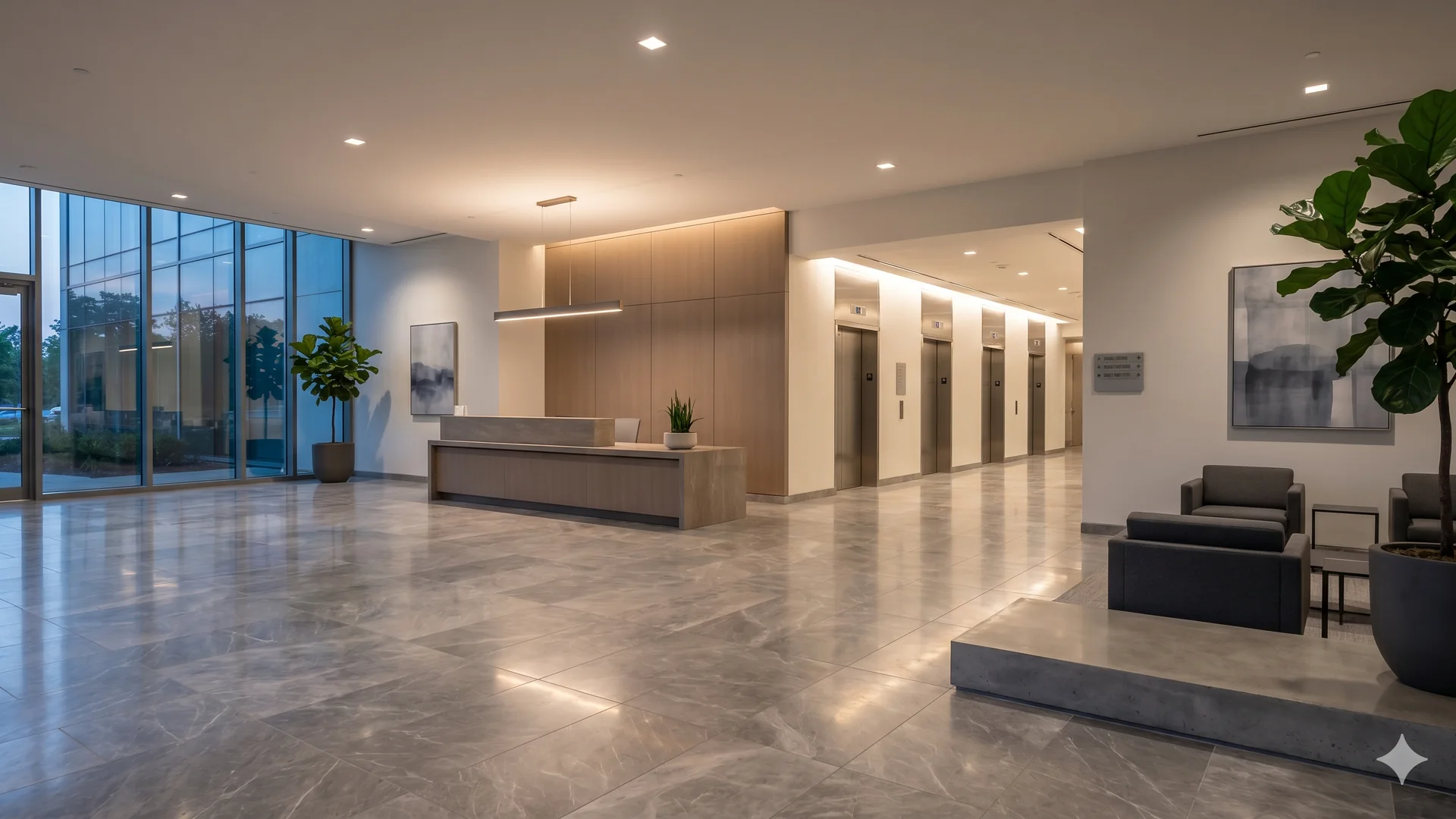
Property managers on Long Island operate in a margin business. Tenant retention drives net operating income, and the condition of common areas is one of the first things prospective and renewing tenants notice. The lobby, the restrooms, the parking garage, the elevator cab, the hallway carpet outside a suite, all of it speaks to whether a building is well run.
This guide is for property managers, asset managers, and management company executives responsible for one or many commercial buildings across Nassau and Suffolk County. It covers the full operational picture for cleaning a multi-tenant building: what work is included under base rent, what is billable to tenants, how to coordinate access across multiple occupants, what insurance and reporting standards to expect from your vendor, and how to consolidate a cleaning program across a portfolio without losing service quality at any individual property.
If you manage a single 50,000 square foot office building or a portfolio of twenty properties from Westbury to Riverhead, the operational decisions are the same, just at different scales. We work with property managers across the full spectrum and have built this guide from the questions we hear most often during RFPs, transition meetings, and quarterly business reviews.
The 15 things every Long Island property manager should understand about cleaning
- Multi-tenant cleaning fundamentals
- Coordinating cleaning across multiple tenants
- Tenant turnover cleaning
- Day porter coverage
- Restroom and common area frequency planning
- Emergency response coordination
- Insurance and certificate of insurance requirements
- Reporting standards owners expect
- Sustainability and ESG reporting
- RFP process for portfolio-wide vendor selection
- Vendor consolidation strategies
- Tenant-billable add-on services
- Managing quality across distributed properties
- Working with building engineers
- What to do when a tenant complains
1. Multi-tenant cleaning fundamentals
A multi-tenant commercial building is not a single facility from a cleaning standpoint. It is a stack of distinct spaces with different cleaning standards, frequencies, and billing arrangements layered on top of shared infrastructure.
The work breaks into three categories. Common areas, which include lobbies, elevators, corridors, common restrooms, stairwells, mailrooms, fitness rooms, and shared conference facilities, are paid for through the operating expense pool and managed by ownership. Tenant suites, the leased premises inside the building, are typically cleaned under direct agreements between the tenant and the cleaning vendor, though the property manager often recommends or even mandates the use of a single preferred vendor. Exterior areas, including parking lots, sidewalks, building entries, dumpster pads, and signage, are operating expenses but cleaned on different frequencies and using different equipment than interior spaces.
The operational distinction matters because the cleaning specification, the inspection process, and the response to complaints all flow differently depending on which area the issue affects. A coffee spill in a shared corridor is fixed under the master agreement. A coffee spill inside a tenant’s reception area is fixed under the tenant agreement if there is one, or handled as an extra-charge service call if not.
A well-built cleaning program names these three zones explicitly in the property management cleaning scope of work and assigns clear ownership for each.
2. Coordinating cleaning across multiple tenants under one contract
A building with eight tenants has eight different schedules, eight different security protocols, and eight different sets of expectations. The cleaning vendor’s job is to deliver consistent results across all of them without becoming an operational headache for the property manager.
Three structural choices make this work. First, a single point of contact on the vendor side, usually a dedicated account manager who knows the building, the tenants, and the property manager personally. Second, a standard cleaning specification for tenant suites that anchors the level of service even when tenants have specific add-ons. Third, a defined process for tenant access, whether that means key sign-out, code-based entry, badge access, or escort by a building engineer, documented per tenant and enforced consistently.
After-hours cleaning is standard for most multi-tenant office buildings because crews work undisturbed and tenants arrive to a clean space. Some tenants, particularly those with sensitive operations like law firms or financial advisors, may require escort or restrict access entirely. Document these preferences in the contract and review them annually. Tenant changes happen, and a cleaning crew that has the wrong access protocol for a new tenant becomes a security incident.
Communication is the other half. Most issues get resolved when the vendor account manager, the property manager, and the affected tenant are all on the same email thread within two hours of an issue surfacing.
3. Tenant turnover cleaning: what is standard and what is billable
When a tenant moves out, the cleaning falls into two buckets. The first is whatever the lease requires the departing tenant to deliver, typically described as “broom clean” condition with carpets vacuumed and surfaces wiped. The second is whatever the landlord needs done before the next tenant takes possession, which is almost always significantly more than broom clean.
Standard make-ready cleaning includes deep cleaning of all hard surfaces, detailed restroom cleaning, glass and mirror polishing, full carpet cleaning, hard floor stripping and refinishing if applicable, baseboard and trim wipe-down, vent and grille cleaning, light fixture cleaning, and removal of any tenant-specific signage residue. Anything beyond this baseline, including paint, drywall patching, ceiling tile replacement, or wall covering replacement, is construction or maintenance, not cleaning.
The pricing model matters here. Some property managers prefer to bundle make-ready cleaning into the annual contract at a flat rate based on historical turnover. Others prefer to bill each turnover as an extra charge against the security deposit or capital reserve. Either approach works, but the bundle approach removes administrative friction and the line-item approach gives owners visibility into actual costs. We can structure either way depending on what management style the property manager prefers.
Post-construction cleaning after tenant build-out is a separate scope entirely. It is heavier, slower, and priced as a one-time project rather than a make-ready cleaning.
4. Day porter coverage and when you need it
A day porter is a cleaning attendant on site during business hours, distinct from the after-hours cleaning crew. The day porter handles real-time tasks: restocking restroom supplies as they run low, addressing spills the moment they happen, cleaning the lobby after the morning rush, policing common areas, handling small requests from the property manager, and providing a visible presence that signals the building is actively maintained.
Whether you need a day porter depends on three factors. Building size matters because larger buildings generate more incidents per day. Tenant mix matters because a building with high foot traffic tenants like medical, retail, or fitness needs day porter coverage that a back-office building does not. And the building’s positioning matters because Class A office and trophy buildings include day porter coverage as part of the experience tenants pay premium rent for.
A typical day porter coverage spec runs eight hours a day, Monday through Friday, with adjustments for buildings open Saturday or Sunday. Some buildings split coverage across multiple porters for peak times. A 200,000 square foot mixed-use building in downtown Huntington with restaurants and retail on the ground floor will run a heavier porter program than a 60,000 square foot single-tenant office on a quiet road in Hauppauge.
Day porter is one of the most visible expense lines in the operating budget, which makes it one of the first cuts under cost pressure. Removing day porter coverage usually shows up in tenant satisfaction surveys within sixty days.
5. Restroom and common area frequency planning
Frequency planning is the single biggest driver of cleaning cost and the single biggest driver of perceived quality. Get it right and tenants stop noticing the cleaning, which is the goal. Get it wrong and the property manager gets emails.
Common restrooms in a multi-tenant office building should be cleaned at least once daily and inspected three times throughout the business day during peak hours. Stocking checks, mirror wipes, sink polishing, and trash inspection happen on the day porter cycle. Full restroom cleaning, including floors, fixtures, partitions, and disinfection, happens overnight. High-traffic buildings or buildings with restaurants and food service need restrooms checked every two hours during operating hours.
Common area floors split by surface type. Hard surface floors in lobbies and corridors should be dust mopped and damp mopped nightly, with deep cleaning monthly and full strip-and-refinish or recoat annually depending on use. Carpet in corridors and lobbies should be vacuumed nightly, spot cleaned as needed, and hot-water extracted quarterly. Glass and entryway tracks need daily attention during winter and rainy season because tracked-in salt and water destroy doors faster than anything else.
Elevator cabs are their own category. The handrails, buttons, mirrors, and flooring all get attention every shift. Elevators are where tenants spend ninety seconds twice a day forming impressions of how the building is run.
6. Emergency response coordination across tenants
Things break. Pipes burst, sewer lines back up, refrigerators leak, employees get sick in restrooms, fire suppression discharges, contractors damage walls. The property manager’s expectation is simple: the cleaning vendor should be reachable, responsive, and capable of handling the call without escalating it back.
A real emergency response program has four pieces. First, a published emergency number that connects to a live person twenty-four hours a day, not a voicemail that promises a call back. Second, a documented response time commitment in the contract, typically one to two hours on the ground for an active issue. Third, the equipment and supplies on hand to handle common incidents, including water extraction equipment, biohazard kits, dehumidifiers, and disinfectant. Fourth, communication discipline that keeps the property manager and the affected tenant informed throughout the response.
Coordination across tenants matters when the incident affects shared infrastructure. A sewer backup in a ground-floor restroom may also affect the upstairs suite if the riser is shared. A fire alarm activation that triggers sprinklers can affect three or four tenants on the same floor. The cleaning vendor needs to operate cleanly across all impacted spaces without becoming the bottleneck for who gets cleaned first.
We respond to property manager emergencies on Long Island around the clock and treat the property management portfolio as a single account, which means a call from one building gets prioritized against the broader workload appropriately.
7. Insurance and certificate of insurance requirements for property managers
Property managers protect ownership by requiring vendors to carry insurance that responds when something goes wrong. The cleaning vendor’s insurance is one of the easiest things to get wrong and one of the most consequential.
A standard certificate of insurance for a Long Island commercial cleaning vendor working in a multi-tenant building should include commercial general liability with limits of at least $1,000,000 per occurrence and $2,000,000 aggregate, automobile liability, workers compensation at New York State statutory minimums and employer’s liability, and an umbrella policy of at least $2,000,000 over the underlying coverages. For larger or higher-value properties, the underlying limits scale up.
The property owner, the property management company, and any lender or other parties named in the lease should all be listed as additional insureds on the general liability policy. The waiver of subrogation, primary and non-contributory language, and any other lease-specific endorsements should match what the lease actually requires. A property manager who accepts a certificate without checking the endorsements is taking on exposure that the certificate does not actually cover.
Workers compensation is the line that gets most cleaning vendors in trouble. Cleaning is heavy physical work and workers compensation claims happen. A vendor that runs subcontractors instead of W-2 employees may carry general liability but not workers compensation that covers the subcontractors, leaving the property owner exposed. Verify W-2 employment, not just the certificate.
8. Reporting standards owners and management companies expect
A modern property management company expects more reporting from cleaning vendors than was standard even five years ago. Owners want visibility into what is happening at their property, and management companies need that data to demonstrate value during quarterly business reviews.
Reporting falls into three layers. Operational reporting is the day-to-day record of work performed: shift logs, supply usage, incident reports, completed punch list items. Quality reporting is the inspection record: periodic property inspections, corrective actions taken, photo documentation of issues found and resolved. Strategic reporting is the quarterly business review document: financial summary, scope changes, recommendations for upcoming year, capital project status.
The format matters less than the consistency. Some property management companies want everything in a portal they already use, like Yardi or AppFolio. Others prefer monthly PDF reports emailed to the property manager and copied to the asset manager. We deliver reporting in whatever format fits into the property manager’s existing workflow rather than asking them to adopt our system.
Photo documentation has become standard. A QBR document that walks through ten property issues and shows before-and-after photos of how each was addressed converts that document from a status update into an asset the property manager can use with ownership.
9. Sustainability and ESG reporting integration
ESG, environmental, social, and governance reporting, has moved from a niche disclosure into a standard expectation for institutional property owners. Pension funds, real estate investment trusts, and large management companies all report environmental performance for their portfolios. Cleaning is part of that picture.
The relevant cleaning data points include the percentage of cleaning chemicals that carry EPA Safer Choice or Green Seal certification, the volume of disposable supplies consumed and the percentage that are post-consumer recycled content, the water consumption associated with cleaning operations, and the diversion of cleaning-related waste from landfill. Newer programs also track the percentage of cleaning staff trained on green cleaning protocols.
For LEED-certified buildings or buildings pursuing LEED EBOM or LEED O+M certification, the cleaning program is a required scope. A vendor that does not understand the LEED green cleaning policy, the green cleaning purchasing policy, and the related documentation requirements will become a problem during recertification audits. We hold green cleaning programs that meet LEED requirements and provide the documentation property managers need for audits.
For property managers serving corporate tenants with their own ESG mandates, the conversation also runs into supplier diversity reporting, fair labor practices documentation, and living wage commitments. These are reasonable asks, and a property manager whose cleaning vendor cannot answer them risks losing the lease renewal.
10. The RFP process for portfolio-wide vendor selection
When a property management company puts cleaning out to bid across multiple buildings, the goal is not the lowest unit price. The goal is the right vendor at a defensible price, with predictable performance, that can scale across the portfolio without service degradation.
A useful RFP has four components. A clear scope of work specific enough to compare bids meaningfully, with cleaning frequencies, included services, day porter hours, and reporting expectations documented for each building. A standardized pricing template that asks for the same data in the same units across all bidders, ideally cost per square foot per month broken down by category. A capability questionnaire that covers insurance, workforce, transition planning, reporting, technology, and references. And a defined evaluation framework that weights price, capability, and references explicitly rather than letting subjective judgment dominate.
The transition plan is where most RFPs underweight risk. Switching cleaning vendors across a multi-building portfolio is operationally complex. Crews need to be hired and trained, keys and access need to be transferred, supplies need to be inventoried, equipment needs to be staged. A vendor that wins the RFP on price but lacks transition capability creates a mess in the first ninety days that the property manager will pay for. We provide a written transition plan with named accountability for every step before contract signature.
References should be checked against properties of similar size, similar tenant mix, and similar age. A glowing reference from a 50,000 square foot single-tenant building tells you very little about how a vendor will handle a 350,000 square foot mixed-use property.
11. Vendor consolidation strategies across the portfolio
Many property management companies have inherited a patchwork of cleaning vendors across their portfolio, with each property using whichever vendor predates the current management contract. Consolidating to one or two vendors across the portfolio creates real operational and financial leverage.
The operational benefit is consistency. One vendor means one set of standards, one reporting format, one point of escalation, one quarterly business review across all properties. That alone is worth real money in property manager time saved. The financial benefit comes from scale pricing, which a single vendor can offer when committing to a portfolio that a per-property vendor cannot.
The risk is concentration. A single vendor that fails affects every property in the portfolio simultaneously. Most property management companies that consolidate do so to two vendors split geographically, which provides redundancy without giving up scale benefits.
Sequencing matters. A consolidation done all at once across twenty properties stretches the new vendor’s transition capability beyond reasonable limits. A phased consolidation over six to nine months, with two or three properties transitioning per month, gives the vendor time to staff, train, and stabilize each property before taking on the next group. We have run multi-property transitions across Long Island portfolios and the phased model produces a much smoother result than the rip-and-replace model.
12. Add-on services you can offer tenants as revenue
Cleaning is not just an operating expense to be minimized. For a property management company, cleaning can be a revenue stream when packaged as add-on services for tenants.
The services that work as revenue add-ons are the ones tenants need but do not want to source independently. Inside-suite cleaning beyond the lease minimum, including kitchenette and conference room cleaning. Window cleaning on interior glass partitions. Carpet cleaning beyond the annual schedule. Stockroom and supply closet organization. Conference room deep cleaning before high-stakes meetings. Office relocation cleaning when a tenant rearranges their floor plan. Special event cleaning for tenant holiday parties or town halls.
The financial model works because the property manager bills the tenant a marked-up rate, the vendor performs the work at a discounted rate against the master agreement, and the property manager captures the spread. For a property managing one million square feet of office, this can amount to a six-figure annual contribution to the management fee.
For this to work the property manager needs a simple ordering process for tenants. An email address that reaches the vendor account manager and the property manager simultaneously, with a 24-hour turnaround for non-emergency requests, is usually all that is needed. Complicated portals reduce adoption.
13. Managing cleaning quality across geographically distributed properties
A property management company with buildings spread from Massapequa to Montauk faces a real challenge. The closest building to the property manager’s office gets visited weekly. The furthest building gets visited monthly. The cleaning quality at the furthest building has no observer between formal inspections.
Three practices close this gap. First, a standardized inspection program with the same scoring rubric used at every property regardless of distance, conducted by the vendor’s regional supervisor not the night cleaner. Second, photo and video documentation of every inspection, stored in a shared portal so the property manager and the asset manager can spot-check without traveling. Third, regular conference calls between the property manager and the vendor account manager focused on the distant properties specifically, not as part of a general portfolio review.
Technology helps but does not replace the operational structure. Real-time issue reporting through a portal, QR code-based shift verification, and digital punch list completion all reduce the friction of running a distributed portfolio. We use these tools where they fit the property manager’s workflow.
The other piece is hiring and training. Cleaning staff who live in the East End of Long Island provide better service at East End properties than crews driving in from the western corridor. A cleaning vendor’s recruitment and training capability across the entire Long Island geography matters as much as its corporate competence.
14. Working with on-site building engineers
The cleaning vendor and the building engineer are the two service providers most often on site after business hours. How well they work together affects everything from access protocols to incident response to capital project execution.
A productive working relationship has four elements. Mutual respect for each other’s domain, with the cleaning supervisor not asking the engineer to mop and the engineer not asking the cleaner to reset a fan coil. Clear coordination on shared equipment, particularly the floor scrubbers, vacuums, and burnishers stored in shared closets. Joint problem-solving for issues that cross the boundary, like an HVAC issue that is depositing dust in common areas. And documented communication when one party identifies an issue that belongs in the other party’s scope.
The building engineer often becomes the early warning system for cleaning issues. The engineer is in the building during business hours, hears tenant complaints, sees problems forming. A cleaning vendor that builds rapport with the engineering team gets ahead of issues. A vendor that treats the engineer as a competitor or a non-stakeholder misses signals constantly.
For property managers, this is a hiring criteria. When interviewing cleaning vendor candidates, ask how they work with on-site engineers. The answer says a lot about how the vendor operates.
15. What to do when a tenant complains about cleaning
Tenant complaints about cleaning are inevitable. Even well-run buildings get them, because expectations vary and individual incidents happen. The question is not whether complaints happen but how the property manager and the cleaning vendor handle them.
The first principle is speed. A tenant complaint that gets a response in two hours becomes a non-event. The same complaint that sits unanswered for two days becomes a renewal risk. The property manager and the cleaning vendor account manager should have agreed escalation paths and response time commitments documented in the contract.
The second principle is honesty. Some complaints are valid because the work was not done. Some are valid because the work was done but not to the tenant’s expectation. Some are not valid because the issue falls outside the cleaning scope or because the tenant misremembers what they reported. Distinguishing these three categories without defensiveness keeps the relationship clean.
The third principle is documentation. Every complaint, the response, the corrective action if any, and the tenant’s confirmation of resolution should be logged. This serves three purposes. It identifies patterns when complaints repeat in the same suite or about the same scope item. It protects the property manager and the vendor when a tenant later argues a complaint was ignored. And it informs the quarterly business review, where complaint trends and resolution times become evidence of how the program is performing.
A vendor that gets defensive about complaints, blames the tenant, or argues over scope is a vendor to replace. A vendor that takes complaints seriously, fixes the issue, documents the resolution, and addresses the root cause makes the property manager’s job easier.
Frequently Asked Questions
What does commercial property management cleaning include on Long Island?
How much does it cost to clean a multi-tenant commercial building on Long Island?
Do property management cleaning contracts cover tenant suites or just common areas?
How fast should a cleaning vendor respond to an emergency call?
What insurance should a property management cleaning vendor carry?
How often should restrooms in a multi-tenant building be cleaned?
Can one cleaning vendor serve an entire property management portfolio?
What is a day porter and when does a building need one?
How is post-construction cleaning different from regular cleaning?
What reporting should a property manager expect from a cleaning vendor?
Talk to E & J Cleaning about your property management portfolio
If you manage commercial property on Long Island and want a cleaning partner that operates the way this guide describes, we would like to talk. E & J Cleaning Services has worked with property managers across Nassau and Suffolk for more than thirty-five years. We treat your portfolio as a single account, provide written transition plans before signature, carry full insurance with property manager-specific endorsements, and deliver reporting in whatever format fits your workflow. For the broader picture, see our complete guide to commercial cleaning on Long Island. Heavy foot-traffic areas often need professional carpet cleaning. See the benefits of professional janitorial services.
Call 1-877-443-2635 or request a walk-through for any property in your portfolio.