Sustainability has moved from a nice-to-have to a business requirement. Long Island building owners chasing LEED certification, corporate tenants with ESG commitments, schools and medical facilities protecting vulnerable occupants, and employers competing for talent all now ask the same question of their cleaning vendor: is this program actually green, and can you prove it? This guide explains what sustainable commercial cleaning really means, which certifications matter, how cleaning supports LEED and ESG goals, and how to build or switch to a credible green program. For the service itself, see our green cleaning services on Long Island, and for the broader commercial picture, our Long Island commercial cleaning guide.
1. What sustainable commercial cleaning actually means
Green cleaning is not just swapping in a bottle labeled “natural.” A genuinely sustainable program is a system: third-party-certified products, equipment engineered to capture rather than redistribute contaminants, methods that reduce water and waste, and documentation that proves all of it. The goal is to clean effectively while minimizing harm to the people in the building, the workers doing the cleaning, and the environment the waste flows into.
That distinction matters because “green” is an unregulated marketing word. What separates a real program from a repainted one is verification: certified products, defined procedures, trained staff, and records. Everything else in this guide builds on that idea.
2. The business case for green cleaning
Sustainability is the headline, but the business reasons are what usually drive the decision. Healthier indoor air means fewer sick days and better productivity, because conventional cleaning chemicals are a significant source of indoor air pollutants. Certified green programs directly support LEED points and ESG reporting, which matters to owners and corporate tenants. Reduced chemical exposure lowers liability and protects cleaning staff. And increasingly, employees and customers simply expect the businesses they work with to operate responsibly.
In other words, green cleaning is rarely bought for the planet alone. It is bought because it improves occupant health, satisfies certification and reporting requirements, reduces risk, and strengthens a brand, with the environmental benefit as a genuine bonus rather than the only selling point.
3. The certifications that actually mean something
Because “green” is unregulated, credible programs lean on independent, third-party certifications. Three carry real weight in commercial cleaning:
EPA Safer Choice is run by the US Environmental Protection Agency and vets every ingredient in a product, including fragrance, against its Safer Chemical Ingredients List; products with any disallowed (“red”) ingredient cannot qualify, and the certified list is publicly searchable. Green Seal sets standards such as GS-37 for general-purpose cleaners, GS-40 for industrial and institutional cleaners, and GS-53 for specialty products, testing toxicity, biodegradability, packaging, and performance; its GS-42 standard is unusual in certifying the cleaning service company itself, not just the products. UL ECOLOGO certifies formulation, packaging, manufacturing, and performance, requiring green products to work as well as conventional ones. A product or provider carrying one of these has been independently tested; a vague “eco-friendly” label on the bottle has not.
4. How green cleaning supports LEED
For buildings pursuing LEED under the Operations and Maintenance (O+M) rating system, cleaning is not optional to the score. LEED requires a written green cleaning policy documenting the products, equipment, procedures, and training in use. Within the Indoor Environmental Quality category, credits reward using certified cleaning products (generally at least 75% by cost meeting Green Seal GS-37, UL ECOLOGO, or EPA Safer Choice), HEPA-filtered and low-noise equipment, and a custodial effectiveness assessment tied to a recognized quality system such as the ISSA CIMS standard.
The practical takeaway for a property manager is that your cleaning vendor is part of your LEED team. The credits depend on certified products, the right equipment, and, above all, documentation, so the ability to supply product certifications, equipment specs, and training records is what turns a cleaning contract into LEED points. Our LEED-compatible cleaning guide goes deeper on the specifics.
5. ESG reporting for corporate clients
Beyond LEED, a growing number of Long Island tenants and companies report against ESG (Environmental, Social, and Governance) frameworks, and facility operations feed directly into that reporting. A certified green cleaning program contributes measurable data points: reduced chemical footprint, lower-impact products, waste and packaging reduction, and safer working conditions for cleaning staff (which touches the “social” side as much as the “environmental” one). For a corporate client, a vendor that can hand over certification documentation and consumption data makes ESG reporting easier rather than harder, which is increasingly a deciding factor in who wins the contract.
6. Microfiber and waste reduction
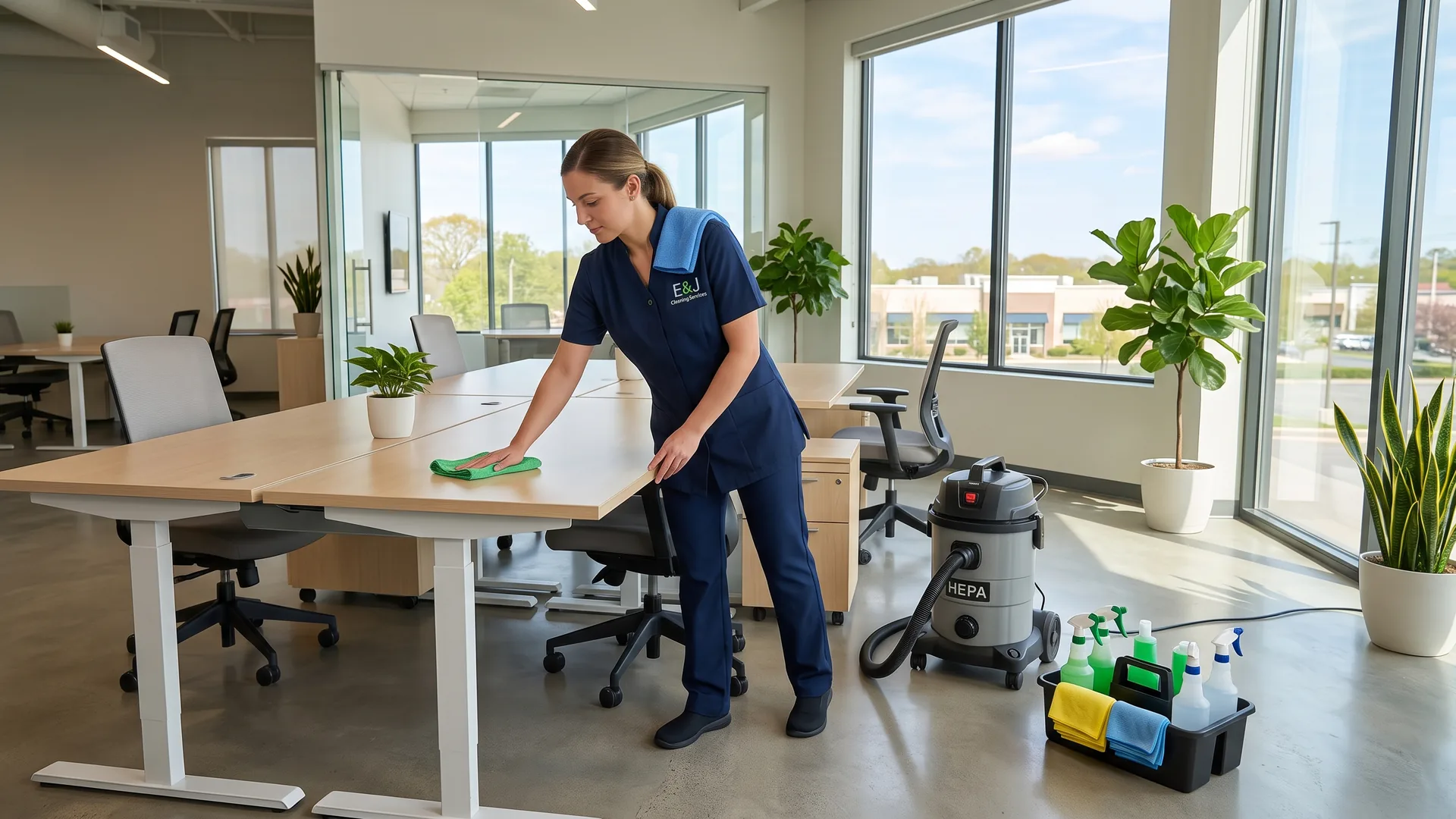
Equipment is half of what makes a program genuinely green, and microfiber is the clearest example. Microfiber cloths and mops capture far more dust and microorganisms than cotton, which means better cleaning with less chemical and less water. Because they are laundered and reused rather than thrown away, they cut disposable waste, and a color-coded system (separate colors for restrooms, kitchens, and general surfaces) prevents cross-contamination without extra product. Swapping paper and cotton for a managed microfiber system is one of the simplest, highest-impact moves in a green transition.
7. HEPA filtration and indoor air quality
The point most often missed about cleaning is that done poorly, it makes indoor air worse, not better. A standard vacuum can pass fine particulate straight through its filter and back into the room, and harsh chemicals add volatile compounds to the air. A green program reverses both: HEPA-filtered vacuums trap fine particles instead of recirculating them, and low-VOC certified products reduce the chemical load. Since people spend the vast majority of their time indoors, and indoor air is frequently more polluted than outdoor air, cleaning that genuinely improves air quality is one of the most direct health benefits a building can offer its occupants.
8. Concentrates and packaging reduction
Ready-to-use spray bottles are mostly water shipped in single-use plastic. Concentrated products, dosed on site through controlled dispensing, cut packaging, shipping weight, and cost at once, while improving safety by standardizing dilution so staff are not free-pouring chemicals. Paired with reusable bottles and bulk delivery, concentrates meaningfully shrink a facility’s cleaning-related plastic waste. It is a small operational change that shows up in both the sustainability numbers and the supply budget.
9. Green cleaning by industry
Sustainability requirements land differently across sectors. In medical and healthcare facilities, low-toxicity products protect immunocompromised patients while still meeting disinfection standards. In schools and daycares, reducing children’s chemical exposure is a leading reason to go green. In food service, green degreasers and sanitizers keep kitchens compliant without harsh residues. In corporate offices and creative studios, green cleaning supports both LEED goals and the employee-experience and ESG stories those companies want to tell. A good program is tailored to the facility rather than applied identically everywhere.
10. Where green cleaning is gaining ground on Long Island
Adoption on Long Island is concentrated where the pressure is highest: LEED-certified and newly built commercial properties whose owners need the credits, corporate tenants with parent-company ESG mandates, healthcare and education facilities protecting sensitive occupants, and property managers responding to tenant demand. The pattern is consistent, the organizations that move first are the ones with a certification to earn, a report to file, or a population to protect. As those requirements spread down from large institutions to mid-sized employers, green cleaning is shifting from a premium option to a baseline expectation across the Suffolk and Nassau commercial market.
11. Cost: green versus conventional
The old assumption that green cleaning costs dramatically more no longer holds. Certified products can carry a higher per-unit price, but that is routinely offset by the efficiencies a green program brings: concentrates reduce product and shipping cost, microfiber cuts consumables and water, and better equipment reduces labor time. Add the harder-to-line-item savings, fewer sick days from better air quality, LEED and ESG value, and lower liability, and a well-designed green program is typically comparable in total cost to a conventional one. The honest way to compare is on the full program and the same scope, not on the sticker price of a single bottle.
12. Transitioning from conventional to green
Switching does not require ripping everything out overnight. A realistic transition audits current products and equipment, replaces the highest-impact items first (general-purpose cleaners, vacuums, and mopping systems), retrains staff on the new methods and dilution, and documents the whole thing so the change is verifiable. Because green cleaning depends as much on method and equipment as on the bottle, staff training is not optional, it is where most of the results come from. A capable vendor manages this transition as a project with a timeline rather than a one-day swap, and our green versus traditional comparison lays out the trade-offs.
13. Greenwashing: how to verify a claim
Because “green” sells, plenty of programs claim it without earning it. The red flags are familiar: vague terms like “natural,” “eco-friendly,” or “non-toxic” with no certification behind them, a logo that looks official but names no standard, an inability to produce product documentation, or a focus on a single green product while the rest of the program stays conventional. The defense is simple: ask for the specific certification (EPA Safer Choice, Green Seal, or UL ECOLOGO), then verify it in the certifier’s public database. A credible provider will hand over that documentation without hesitation. If a vendor cannot name and prove a standard, the program is marketing, not sustainability.
14. Where sustainable cleaning is headed
The direction of travel is toward more transparency and less tolerance for vague claims. Ingredient disclosure is becoming standard, certifications are tightening their criteria, and buyers, especially institutional ones, increasingly require documentation rather than taking a label at face value. Technology is pushing the same way, from more efficient equipment to better dosing systems that cut waste. For facilities, the practical implication is that a green program built on verifiable certifications and good records today is one that stays compliant as expectations rise, while a program resting on marketing language will have less and less room to hide.
15. How to start a green cleaning program
Getting started is more straightforward than it looks:
- Define why: LEED credits, ESG reporting, occupant health, or all three – the goal shapes the program.
- Choose a vendor that uses genuinely certified products (Green Seal, EPA Safer Choice, or UL ECOLOGO) and can provide documentation.
- Prioritize high-impact swaps first: general-purpose cleaners, HEPA-filtered vacuums, and a microfiber system.
- Train staff on the new methods, since green results depend on technique and equipment as much as products.
- Document everything – products, equipment, procedures, and training – so the program supports certification and reporting.
- Review and improve on a schedule rather than treating it as one-and-done.
E & J’s green cleaning service is built around these steps, and for the wider vendor-selection process our commercial cleaning guide walks through what to ask.
The health case: what conventional cleaning chemicals do
Many conventional cleaners release volatile organic compounds (VOCs) and harsh fumes that linger in indoor air long after the cleaning is done. For occupants, that can mean headaches, irritated eyes and airways, and aggravated asthma, and the people most exposed are the cleaning staff who handle the products daily. Green programs are built to remove that burden: certified low-VOC products, better ventilation-friendly methods, and equipment that captures rather than stirs up particulate. The result is a building that is not just visibly clean but measurably healthier to occupy, which is the whole point of cleaning in the first place.
Green equipment and technology
Products get the attention, but equipment is where a lot of the sustainability actually happens.
- HEPA-filtered vacuums trap fine particulate instead of recirculating it into the air.
- Automated dilution control doses concentrates precisely, eliminating overuse and free-pouring.
- Microfiber systems clean with less chemical and water and are laundered rather than discarded.
- Low-moisture and low-noise floor machines reduce water use and let cleaning happen during occupied hours.
- Electrostatic and no-touch systems apply product efficiently with less waste for disinfection tasks.
Matching the right equipment to the facility is often what separates a program that hits its sustainability targets from one that only changes the label on the bottle.
Water and resource efficiency
Sustainability is not only about chemicals. Traditional mopping and auto-scrubbing can use large volumes of water, much of it wasted. Microfiber flat-mop systems use a fraction of the water of a string mop and bucket, low-moisture floor equipment cuts it further, and concentrate-and-dispense systems reduce both packaging and the fuel spent shipping water-heavy ready-to-use products. Across a portfolio of buildings, those reductions in water, plastic, and transport add up to a meaningful part of a facility’s environmental footprint, and they usually lower operating cost at the same time.
Certifying the cleaning company, not just the products
Most certifications cover products. A smaller set certify the provider. Green Seal’s GS-42 standard and the ISSA’s CIMS-Green Building (CIMS-GB) program evaluate how a cleaning company actually delivers a green program: its procedures, training, quality systems, and documentation. For a facility pursuing LEED or answering to an ESG framework, a company-level certification is meaningful evidence that green cleaning is built into how the vendor operates rather than being a box of special products kept for show. When it matters, ask not only whether the products are certified but whether the provider’s program is.
What to require of a green cleaning vendor
If you are putting a green program out to bid or upgrading an existing contract, build the requirements in rather than hoping for them:
- Certified products (Green Seal, EPA Safer Choice, or UL ECOLOGO) with documentation for each.
- HEPA-filtered equipment and a managed microfiber system.
- A written green cleaning policy covering products, equipment, procedures, and training.
- Staff training records demonstrating green-cleaning proficiency.
- Reporting you can use for LEED credits or ESG disclosure.
- A named path to verify every certification claimed.
Writing these into the scope turns “green” from a promise into a deliverable, and it makes vendors easy to compare on the same terms.
Green disinfection: safety and sustainability together
Disinfection is where facilities most often assume they have to abandon green principles, but they do not. The EPA registers disinfectants for efficacy, and its Safer Choice-aligned and Design for the Environment antimicrobial listings identify products that kill pathogens with a lower toxicity profile. Paired with electrostatic or controlled application, certified disinfectants let a facility meet its infection-control needs without saturating the space in harsh chemistry. The key is dwell time and correct use rather than brute strength, which is exactly what a trained green program is built to deliver. Effective disinfection and a low chemical burden are not opposites when the products and methods are chosen deliberately.
Day cleaning and energy savings
A quieter, lower-VOC green program makes daytime cleaning practical, and daytime cleaning is itself a sustainability move. When cleaning happens during occupied hours instead of late at night, a building can cut the hours it runs lights and HVAC for an empty space, trimming energy use and cost. It also improves oversight and responsiveness. Day cleaning only works when the equipment is low-noise and the products are low-odor, which is precisely what a green program provides, so the two reinforce each other.
Measuring and reporting results
What gets measured gets managed, and green programs live or die on documentation. A mature program tracks the certifications and consumption of the products in use, the equipment specifications, staff training completion, and, where relevant, indoor air quality monitoring. That data does double duty: it proves the program is real for LEED and ESG purposes, and it surfaces where the program can improve, such as a product that could be swapped or a process using more water than it needs. For corporate and institutional clients especially, the reporting is not paperwork for its own sake, it is the deliverable that makes the program count.
Common myths about green cleaning
Three myths keep facilities from switching, and none survive contact with a real program. The first is that green cleaning does not work as well; in fact, certifications like UL ECOLOGO require equal performance, and HEPA and microfiber often clean better. The second is that it always costs more; on a full-program basis, efficiencies usually make it comparable. The third is that “green” is meaningless marketing; it is meaningless only when there is no certification behind it, which is exactly why verifiable standards exist. A program built on real certifications answers all three.
Green cleaning FAQ
What actually makes cleaning “green”? A system, not a single product: third-party-certified products, HEPA-filtered and low-impact equipment, methods that reduce water and waste, and documentation. “Green” on a bottle with no certification behind it means nothing.
Which certifications should I look for? EPA Safer Choice, Green Seal (GS-37, GS-40, GS-53, or GS-42 for service companies), and UL ECOLOGO. Each is independently tested and verifiable in a public database.
Does green cleaning cost more? Certified products can cost more per unit, but concentrates, microfiber, and efficient equipment usually offset that, so a well-designed green program is typically comparable in total cost to a conventional one.
Does green cleaning work as well as conventional? Yes. Certifications like UL ECOLOGO require green products to perform at the same level as conventional ones, and microfiber and HEPA equipment often clean better, not worse.
Does green cleaning help with LEED or ESG? Directly. LEED O+M requires a written green cleaning policy and rewards certified products and equipment, and a documented green program feeds measurable data into ESG reporting.
Is it worth it for a small office? Yes. Even without a certification to chase, better indoor air quality and lower chemical exposure benefit any workplace, and small facilities can adopt the high-impact pieces easily.
How do I avoid greenwashing? Ask for the specific certification and verify it in the certifier’s public database. If a vendor cannot name and prove a standard, treat the claim as marketing.
Do you offer green cleaning on Long Island? Yes. Explore our green cleaning services, available to commercial facilities across Suffolk and Nassau.
Talk to E & J about a green program
Whether you are chasing LEED credits, reporting against ESG goals, or simply want a healthier building, a credible green cleaning program is easier to run than most facilities expect, provided it is built on real certifications and good documentation. E & J Cleaning can design and manage that program for your facility. Call 1-877-443-2635 or explore our green cleaning services on Long Island to get started.