Every medical practice on Long Island carries a set of obligations that a law office or a retail store never thinks about. Patients arrive sick. Some arrive immunocompromised. Exam tables, waiting room chairs, and check-in counters are touched by hundreds of hands a week. Records with protected health information sit in every room. Federal rules govern how bloodborne pathogens are handled and state rules govern how infections are reported. When something goes wrong, the regulatory exposure lands on the practice, not on the cleaning company.
This guide is for the practice managers, office administrators, and physician owners who are responsible for keeping a healthcare facility clean, compliant, and inspection-ready. It covers what actually separates medical cleaning from ordinary commercial cleaning, what HIPAA does and does not require of your cleaning vendor, what OSHA requires of the crews themselves, how disinfectants and protocols differ by practice type, and how to evaluate, hire, and switch cleaning vendors without opening a compliance gap.
We have written it the same way we wrote our Complete Guide to Commercial Cleaning on Long Island: from the questions we hear during walk-throughs, bids, and quarterly reviews with practices from Stony Brook to Patchogue. Where a rule has a source, we cite the source. Where a common vendor claim is wrong, we say so.
The 16 things every Long Island practice should understand about medical cleaning
- Why medical office cleaning is different
- The regulatory map: who actually governs cleaning in a NY practice
- HIPAA and your cleaning vendor: what is actually required
- The OSHA Bloodborne Pathogens Standard for cleaning crews
- EPA-registered hospital-grade disinfectants, explained
- Terminal cleaning vs daily cleaning vs between-patient cleaning
- Protocols by practice type
- Documentation your practice should require from a vendor
- Vetting the people: background checks, W-2 crews, consistency
- Audit and inspection readiness
- Outbreak and incident response
- Biohazards: what a cleaning crew can and cannot do
- Where medical practices cluster on Long Island
- Cost considerations for medical office cleaning
- Choosing a medical cleaning vendor: a 10-question checklist
- Switching vendors without a compliance gap
1. Why medical office cleaning is different from commercial office cleaning
A standard commercial office is cleaned so it looks and feels clean. A medical office is cleaned so it is clinically clean, which is a different standard achieved with different products, different techniques, and different training.
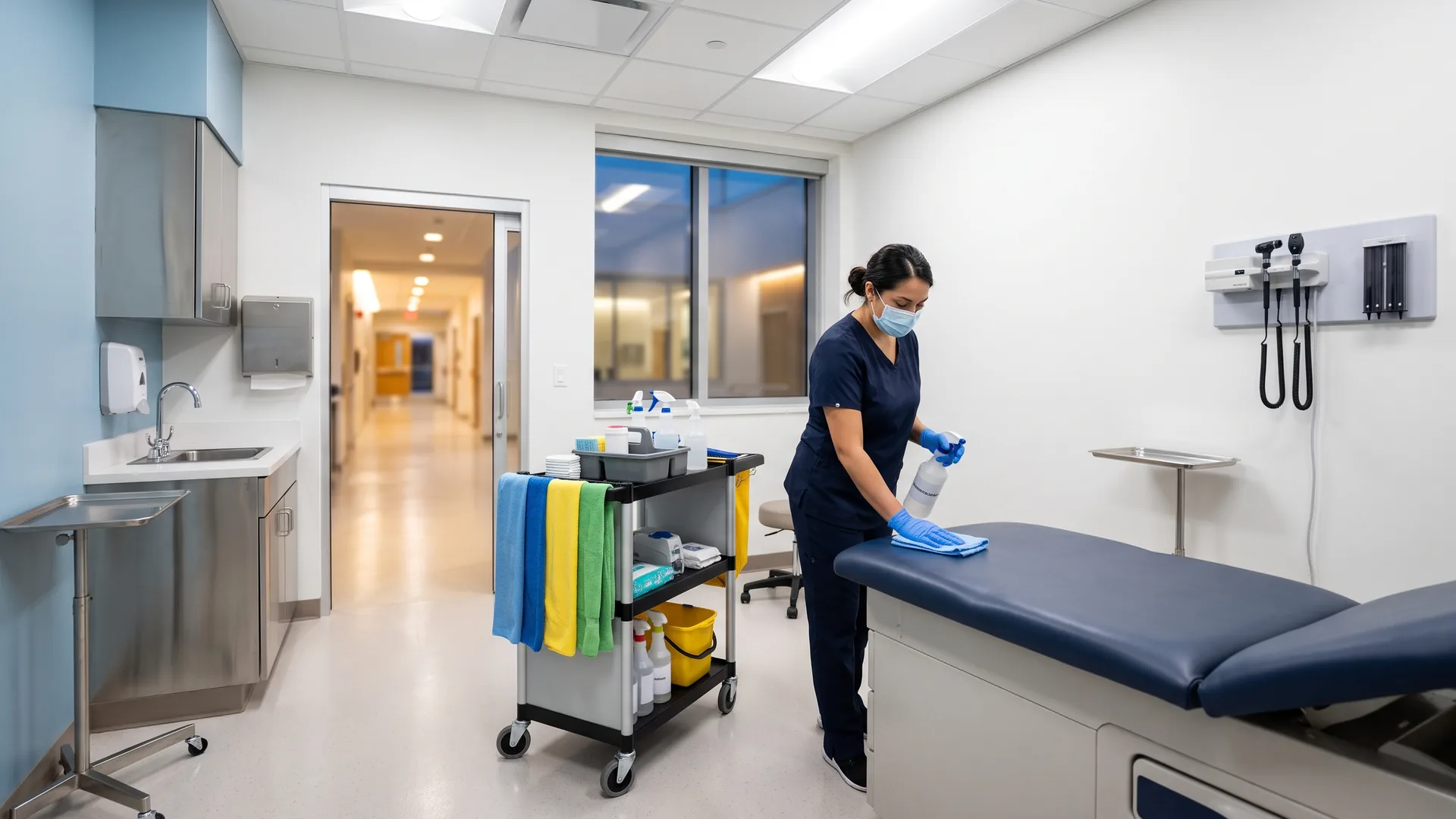
The difference starts with who uses the space. In an ordinary office, the population is stable and generally healthy. In a medical office, the waiting room concentrates people who are actively contagious, and the exam rooms serve patients whose immune systems may not tolerate exposures a healthy person would shrug off. The surfaces those patients touch, exam tables, armrests, door handles, check-in counters, card readers, pens, and clipboards, turn over between users all day.
The difference continues with what clean means. Cleaning removes visible soil. Disinfection kills pathogens on a surface, and it only works when an appropriate EPA-registered product is applied to a pre-cleaned surface and left wet for the full contact time on its label. A crew that sprays and immediately wipes has cleaned the surface without disinfecting it. In a general office that distinction rarely matters. In a medical office it is the entire job.
The difference ends with who carries the risk. If a general office is cleaned poorly, someone complains. If a medical office is cleaned poorly, the practice absorbs infection control risk, inspection risk, and reputational risk with patients who notice the condition of a restroom and draw conclusions about the condition of the autoclave. That asymmetry is why medical office cleaning is a specialty discipline and not a line-item upgrade to a standard janitorial contract.
2. The regulatory map: who actually governs cleaning in a New York medical practice
Cleaning vendors love to imply that a single agency audits medical office cleanliness and that hiring them satisfies it. The real map is more specific, and knowing it puts you in control of vendor conversations.
Article 28 facilities are one world. Hospitals, nursing homes, ambulatory surgery centers, and diagnostic and treatment centers are licensed under Article 28 of the New York Public Health Law and answer to the New York State Department of Health, including for infection control and sanitary environment standards. If your organization is an Article 28 facility, your cleaning program is part of your licensure survey scope.
Private practices are another. A privately owned physician or dental practice is not an Article 28 facility. Oversight runs instead through professional licensing, which is why New York requires infection control training for physicians, dentists, and other licensed professionals, and through the local health department, which is where private practices report suspected healthcare-associated infections. On Long Island that means the Nassau and Suffolk county health departments play a reporting and investigation role, not a routine cleaning-inspection role.
OSHA is the constant. Whatever the practice type, OSHA’s Bloodborne Pathogens Standard applies to employees with occupational exposure, including cleaning crews. Section 4 covers this in detail.
One practical takeaway: there is no such thing as a “HIPAA certified” or “DOH certified” cleaning company. No agency certifies cleaning vendors for medical work. A vendor using that language is at best sloppy and at worst hoping you will not check. What a good vendor can show you is real: training records, an exposure control plan, product documentation, and insurance. The rest of this guide covers what those look like.
3. HIPAA and your cleaning vendor: what is actually required
HIPAA generates more confusion in cleaning contracts than any other topic, so here is the rule as the federal government states it.
The U.S. Department of Health and Human Services addresses cleaning services directly in its guidance (HHS FAQ 243). A business associate agreement is generally not required for janitorial services, because the work does not involve the use or disclosure of protected health information. When a cleaner glimpses a chart while emptying a trash can, that is incidental exposure, a by-product of the job that cannot reasonably be prevented, and it does not make the cleaning company a business associate.
The exception matters just as much. If the vendor’s scope includes handling PHI, for example shredding or destroying records, moving patient files, or accessing systems that contain electronic PHI, the vendor becomes a business associate and a BAA is required. Scope, not job title, determines the answer.
So what should a practice actually require of its cleaning vendor? Four things, and all of them are about behavior rather than paperwork theater. Staff assigned to your facility should be trained never to read, photograph, move, or discuss anything containing patient information. The vendor should have signed confidentiality agreements with its own employees. The crew should work around desks, charts, and screens rather than through them, leaving documents exactly where they were found. And the vendor should be willing to sign a BAA without argument whenever your compliance officer or scope of work calls for one.
That last point is our own practice. E & J trains every crew member assigned to a medical account in HIPAA-conscious cleaning, and we sign BAAs on request. We would rather explain the rule accurately and let you decide than wave a certification that does not exist. For a deeper treatment of this topic, see our post on HIPAA cleaning requirements for Long Island medical offices.
4. The OSHA Bloodborne Pathogens Standard for cleaning crews
The OSHA Bloodborne Pathogens Standard, 29 CFR 1910.1030, is the federal rule that most directly governs the people cleaning your facility. It applies to any employee with reasonably anticipated occupational exposure to blood or other potentially infectious materials, and a cleaning crew working in a medical office fits that definition.
A compliant cleaning employer must have four things in place. First, a written exposure control plan that identifies which tasks carry exposure risk and how that risk is controlled, reviewed and updated annually. Second, annual bloodborne pathogens training for every exposed employee, delivered at hire and repeated every year. Third, a hepatitis B vaccination series offered at no cost to exposed employees. Fourth, personal protective equipment, gloves at minimum and gowns or face protection where warranted, provided by the employer and actually used.
The standard also contains housekeeping provisions that speak directly to cleaning work: worksites must be maintained clean and sanitary under a written schedule that specifies the method of decontamination by surface and task, contaminated sharps must never be picked up by hand, and broken glassware must be handled with mechanical means like tongs or a brush and dustpan.
When you evaluate a cleaning vendor, this is the section to press on. Ask to see the exposure control plan. Ask when each crew member assigned to your account last completed BBP training and whether the hepatitis B offer is documented. A vendor that services medical accounts and cannot produce these has told you everything you need to know. The obligations sit with the cleaning company as employer, but the exposures happen inside your facility, which makes their compliance your business.
5. EPA-registered hospital-grade disinfectants, explained
Every disinfectant legally sold in the United States carries an EPA registration number, and that number ties the product to tested, approved claims. “Hospital-grade” or “hospital disinfectant” means the product has passed EPA efficacy testing against benchmark organisms including Staphylococcus aureus and Pseudomonas aeruginosa. The EPA also maintains product lists for specific pathogens, including List N for products expected to kill SARS-CoV-2, which the agency continues to maintain.
Three things on a label matter more than the brand name. The registration number, which lets you verify the product and its claims. The kill claims, which name the organisms the product is proven against, and this is where distinctions matter, because a product effective against influenza and MRSA is not necessarily sporicidal, and Clostridioides difficile spores require a sporicidal product, typically bleach-based or otherwise specifically registered for spores. And the contact time, the number of minutes the surface must remain visibly wet for the product to work.
Contact time is the most commonly violated instruction in commercial cleaning. Many hospital-grade products require several minutes of wet contact. A crew moving at general-office speed, spraying and wiping in one pass, delivers a fraction of the labeled efficacy no matter how good the product is. Technique, not chemistry, is usually the gap.
At E & J we use EPA-registered hospital-grade disinfectants across our medical accounts, apply them to pre-cleaned surfaces, and train crews on dwell times by product. Our Sporicidin program covers the sporicidal end of the spectrum. For practices that want to reduce chemical load in non-critical areas, our green cleaning program pairs environmentally responsible products in offices and common areas with hospital-grade disinfection where patient care happens. The two are not in conflict; they are zoned.
6. Terminal cleaning vs daily cleaning vs between-patient cleaning
Medical cleaning runs on three tiers, and a well-written scope of work names who owns each one.
Between-patient cleaning is the wipe-down of the exam table, paper change, and disinfection of immediate contact surfaces after each patient. In nearly every outpatient practice this is done by clinical staff, medical assistants or hygienists, because it happens dozens of times a day during operating hours. Your cleaning vendor does not own this tier, but a good vendor stocks and stages the supplies for it and keeps dispensers filled.
Daily cleaning is the vendor’s core work, performed after hours. In a medical office it means disinfection of every high-touch surface in exam rooms, waiting areas, and restrooms, trash and regulated-waste-adjacent housekeeping within the limits described in Section 12, floors mopped with disinfecting solution rather than general floor cleaner, and restrooms brought to a sanitation standard well above office norms because patient restrooms see sicker users and heavier use.
Terminal cleaning is the deepest tier: a top-to-bottom disinfection of a room or suite, walls and horizontal surfaces included, equipment moved rather than cleaned around. Hospitals do it when an isolation patient is discharged. In outpatient settings it appears on a schedule, monthly or quarterly for procedure rooms, and on demand after an exposure event, a norovirus incident, or ahead of an inspection.
Frequency should map to room type. Exam rooms and restrooms get the full disinfection tier nightly. Waiting rooms get high-touch disinfection nightly with periodic deep work on upholstery and toys. Procedure rooms get nightly disinfection plus scheduled terminal cleans. Administrative areas can run on a standard commercial spec. Paying for a single undifferentiated spec across all four is how practices overpay for offices and underclean exam rooms.
7. Protocols by practice type
The compliance frame is the same everywhere, but the work changes with the medicine. This is what shifts by practice type.
Dental and orthodontic. Handpieces and ultrasonic scalers generate aerosols that settle on surfaces well beyond the chair, so evening cleaning must treat the full operatory as a contact zone, not just the visible work area. Lab benches where impressions and appliances are handled need their own disinfection pass. Suction and spittoon areas are cleaned to a clinical standard nightly.
Dermatology and cosmetic surgery. Procedure rooms where injections, biopsies, and laser work happen are held to the highest outpatient standard, with scheduled terminal cleans in addition to nightly disinfection. Post-procedure patients are more infection-vulnerable than typical office visitors, which raises the bar in recovery and consult rooms too.
Primary care and pediatrics. The waiting room is the epidemiological center of the practice. Nightly disinfection of every seat, arm, and shared surface matters more here than anywhere, and pediatric practices need a toy and play-surface rotation so shared objects are disinfected or cycled out on a schedule, especially through Long Island’s winter virus season.
Urgent care. Extended hours compress the cleaning window and raise acuity. Urgent care sees the sickest walk-in population and often needs a mid-day porter-style touch on restrooms and waiting areas in addition to nightly service.
Physical therapy and chiropractic. The exposure here is shared equipment: mats, tables, benches, and handles touched by a rotating cast of patients in athletic contact. Between-patient wipe-downs are staff work, but the nightly program must reach every mat and contact surface, and the vendor should know which disinfectants will not degrade mat and upholstery materials.
Veterinary and optometry. Adjacent verticals with their own wrinkles: animal-safe disinfection and odor control on one side, high-touch diagnostic equipment surfaces handled with optics-safe technique on the other.
If your practice type is not listed, the mapping exercise is the same: identify where patients and pathogens concentrate, then set the disinfection tier and frequency room by room.
8. What documentation your practice should require from a cleaning vendor
A medical cleaning program you cannot document is a program you cannot defend, to an inspector, an accreditor, an insurer, or a plaintiff’s attorney. Before a vendor’s crew enters your facility, four categories of paperwork should be on file.
Insurance and bonding. A current certificate of insurance showing general liability and workers compensation, with your practice named as additional insured, plus crime and dishonesty bonding on the people who will hold your keys and alarm codes. Verify annually; do not file and forget. Our post on insurance, bonding, and liability in cleaning contracts explains what each policy actually covers and the limits to look for.
Training records. Bloodborne pathogens training dated within the last year for every crew member assigned to your account, plus the vendor’s HIPAA-awareness onboarding materials. Named people, real dates, not a blanket statement that “all staff are trained.”
Chemical documentation. A product list with EPA registration numbers for every disinfectant used in your facility, and safety data sheets accessible on site. Your own staff has a right to know what is being applied to the surfaces they work on, and an inspector may ask.
Operational records. A written scope of work by room type, nightly cleaning logs, and periodic inspection reports from the vendor’s supervisor. The logs are what turn “we clean it every night” into evidence.
A vendor that produces all four without friction is a vendor that has done medical work before. A vendor that stalls on any of them is telling you where the gaps are.
9. Vetting the people: background checks, W-2 crews, and consistency
Every question in the last section was about paper. This one is about the people the paper describes, because after hours your facility belongs to them.
A medical office concentrates three things worth stealing or mishandling: drugs, records, and equipment. That makes the staffing model behind your cleaning contract a compliance issue, not a procurement detail. The questions that matter: Who employs the person in my building tonight? Who background-checked them, and to what standard? Who trained them, and who answers when something goes wrong?
With a W-2 cleaning company, those answers run through one chain. The company hired, screened, trained, insured, and supervises the crew. With a subcontractor model, each answer depends on a chain of relationships you cannot see, and background check verification is often the first link to fail. We wrote a full breakdown of the difference in Subcontractors vs W-2 Crews; for medical facilities the short version is that routine janitorial scope in a space with patient records and a drug cabinet should be serviced by directly employed, background-checked, consistently assigned staff.
Consistency is the underrated third leg. A crew that services your practice every night learns which rooms are procedure rooms, which cabinets stay locked, which areas are off limits, and what your protocols require. A rotating cast relearns your facility from zero each time, and every relearning is an error window. Ask your vendor how crew assignment works and what happens when your regular crew member is out. The answer should be a named, trained backup, not whoever is available.
10. Audit and inspection readiness
Inspections and accreditation reviews rarely fail a practice on cleanliness alone, but cleanliness shapes the entire encounter. A reviewer who sees dusty vents, stained ceiling tiles, and an overflowing sharps-adjacent trash can starts looking harder at everything else. A facility that presents clean buys credibility for its clinical compliance.
A documented cleaning program contributes to your compliance file directly. The scope of work, product list with EPA registration numbers, training records, and nightly logs described in Section 8 are exactly the artifacts that answer a reviewer’s environmental questions. Practices pursuing accreditation, and practices tied into hospital systems’ vendor requirements, should treat the cleaning vendor’s file as part of their own.
Readiness also has a short-notice mode. When an inspection is announced for tomorrow morning, or a licensure survey window opens, a practice needs a deep clean tonight: floors, vents, high dusting, restrooms to terminal standard, waiting room furniture, and every surface a reviewer touches on a walk-through. Ask your vendor now, not then, what their response window is for a same-week deep clean and whether after-hours emergency response is part of the contract. Our emergency cleaning service exists for exactly this call.
The cheapest insurance is a quarterly walk-through with your vendor’s supervisor using the reviewer’s eyes: start at the parking lot, walk the patient path, and note everything a stranger would see before they see your clinical work.
11. Outbreak and incident response
When a pathogen event hits a practice, the cleaning program shifts modes, and the shift should be pre-planned in the contract rather than improvised on the phone.
Norovirus is the scenario that breaks general-office protocols, because many quaternary disinfectants are weak against it. Response means switching to a product with a norovirus kill claim, or a bleach-based protocol, extending disinfection to every surface within the affected zone, and treating restrooms as the epicenter. Influenza and COVID surges call for raised frequency on waiting room and high-touch disinfection through the surge window, with product choice verified against EPA lists. MRSA concerns center on exam surfaces and equipment contact points, with hospital-grade products already proven against it. C. difficile, rare in outpatient settings but serious, requires a sporicidal product; a standard disinfectant pass provides false comfort.
An exposure event, a patient later confirmed contagious, a body fluid incident in a waiting room, a staff illness cluster, should trigger a defined enhanced clean of the affected zone the same night, documented in the log like any other service. Speed matters, which is why response windows belong in the contract. E & J runs 24/7 emergency response across Long Island; whoever your vendor is, get the response commitment in writing before you need it.
One caution: outbreak response is enhanced environmental cleaning, not magic. If an event rises to the level of regulated medical waste, contaminated sharps, or trauma scene remediation, it crosses into territory covered in the next section.
12. Biohazards: what a cleaning crew can and cannot do
The line between janitorial work and biohazard work is drawn by regulation and training, and a vendor that blurs it is a liability to your practice.
What a properly trained cleaning crew can do. Clean and disinfect surfaces in clinical areas. Respond to routine body fluid spills, vomit, urine, small blood spills, using BBP-trained procedures: PPE on, absorb, clean, disinfect with an appropriate product, dispose per protocol. Handle restroom biohazard conditions. Maintain the housekeeping standards the OSHA rule requires.
What a cleaning crew must never do. Handle contaminated sharps, ever. Sharps live in the practice’s sharps containers, and full containers are closed and staged by clinical staff for the licensed hauler. Cleaning staff who find a loose needle stop and report it; the OSHA standard itself prohibits picking up contaminated sharps by hand. Transport or dispose of regulated medical waste: red-bag waste is manifested and hauled by the practice’s licensed medical waste contractor under New York’s regulated medical waste rules. Your janitorial vendor handles ordinary trash and leaves the red-bag stream to the licensed chain of custody. Perform trauma or crime scene remediation: large-volume blood events and trauma scenes are a specialty remediation discipline with its own certification and containment standards.
Practices occasionally ask a cleaning vendor to “just take the red bags out.” A vendor that says yes is exposing both parties. The correct division of labor, cleaning vendor for environment, licensed hauler for regulated waste, clinical staff for sharps, is not bureaucracy. It is the version where every actor is trained and insured for exactly what they touch.
13. Where medical practices cluster on Long Island
Long Island’s medical geography is not evenly distributed, and we built our service model around where care actually concentrates in central and eastern Suffolk.
The gravitational center is the Stony Brook medicine ecosystem, where the university hospital anchors a dense ring of physician practices, specialty groups, and research-adjacent facilities that hold vendors to academic-medical standards. Port Jefferson and Port Jefferson Station form a second cluster around Mather Hospital, with medical and dental offices threaded through the Route 112 corridor. Smithtown and neighboring Nesconset support a professional corridor along Smithtown Boulevard with a notable concentration of medical and dental practices. Hauppauge mixes medical tenants into Long Island’s largest office and industrial park, where practices often sit inside multi-tenant buildings with their own cleaning coordination questions, the subject of our Property Manager’s Guide. And Patchogue anchors care on the South Shore with hospital-adjacent practices and a growing downtown professional base.
E & J Cleaning is headquartered in Coram, which puts every one of these clusters inside a short response radius for both nightly service and same-day emergency calls. If your practice sits elsewhere in Suffolk, our service area directory covers the full list of communities we serve.
14. Cost considerations for medical office cleaning
Medical cleaning costs more than general office cleaning, and a practice should understand exactly what the premium buys before comparing bids.
The premium has four honest drivers. Labor: crews with annual BBP training, hepatitis B vaccination offers, HIPAA-conscious onboarding, and background checks cost more to employ than general cleaners. Products: EPA-registered hospital-grade disinfectants, and sporicidal products where needed, cost more than general-purpose chemicals. Time: honoring contact times and disinfecting every high-touch surface takes longer per square foot than a spray-and-wipe office pass. Documentation: logs, training records, and COI maintenance are real administrative work.
Structures vary, but most Long Island medical accounts price as a monthly contract based on square footage, room mix, and frequency, with exam-room-heavy layouts pricing above administrative-heavy ones. Terminal cleans, emergency response, and inspection-prep deep cleans are typically scoped as add-ons or retained response commitments.
The comparison that matters is not medical cleaning versus general cleaning. It is medical cleaning versus the false economy of putting a general cleaner in a medical space: a lower invoice, purchased with untrained staff around your records and sharps, undocumented products on your surfaces, no exposure control plan behind the person doing the work, and nothing to hand an inspector. The gap between the two bids is usually small against the practice’s revenue. The gap between the two risk positions is not.
Get a real number for your own facility rather than a benchmark: a walk-through and a written scope cost nothing. Request a free estimate and we will price your actual room mix.
15. Choosing a medical cleaning vendor: a 10-question checklist
Put these ten questions in your next RFP or vendor conversation. The answers separate medical-capable vendors from general cleaners with a medical page on their website.
- Do you have a written OSHA exposure control plan, and may we see it? The foundational document. No plan, no medical account.
- When did the crew members assigned to our facility last complete bloodborne pathogens training? Named people, dates within twelve months.
- Are your crews W-2 employees, and are they background-checked? In a facility with drugs and records, both answers must be yes, verifiable.
- What EPA-registered disinfectants will you use here, and what are their contact times? They should answer with registration numbers and dwell times, not brand slogans.
- How do you handle HIPAA? The right answer explains incidental exposure, confidentiality training, and willingness to sign a BAA when scope requires. The wrong answer is “we’re HIPAA certified.”
- Will the same crew service our facility every night, and who is the trained backup? Consistency is a compliance control.
- What will you document, and what do we receive? Nightly logs, inspection reports, training records, current COI naming the practice as additional insured.
- What is your emergency and outbreak response commitment, in hours? Get it in the contract.
- Where is your line on biohazards, sharps, and regulated medical waste? The correct answer matches Section 12. A vendor who offers to take red bags fails.
- Which medical practices on Long Island can we call as references? Specialty-relevant references, not generic office accounts.
Score the bids on these ten before price enters the conversation. A vendor who clears all ten at a higher price is cheaper than a vendor who fails three at a lower one.
16. Switching vendors without a compliance gap
Practices tolerate mediocre cleaning vendors for years because switching feels risky in a compliance environment. Done in order, it is not.
Before notice. Get the incoming vendor’s file complete first: COI naming the practice, exposure control plan, training records, product list, and signed BAA if your scope requires one. The compliance file transfers before the mop does.
The overlap week. Have the incoming vendor walk the facility with your office manager while the outgoing vendor is still on duty. Room-by-room scope, keys and alarm protocols, locked areas, product staging, and the location of every log. If the outgoing relationship is civil, one overlap night where the new crew shadows the space is worth more than any document.
Cut-over. Change alarm codes and collect keys on the last night of the old contract, not a week later. Start the new vendor’s logs on night one so there is no undocumented gap in your file. If the switch happens mid-quarter, schedule a terminal clean of clinical areas as the incoming vendor’s first weekend project, which resets the baseline and surfaces any condition issues the old vendor left behind.
The first ninety days. Weekly supervisor walk-throughs for the first month, then biweekly, with punch lists documented and closed. Hold the vendor to the response windows in the contract from day one; the first month sets the norms for the relationship.
The pattern in all four phases is the same one running through this whole guide: in a medical facility, the cleaning program is part of the compliance program. Treat the vendor change with the same documentation discipline you would apply to any other vendor who touches patient-adjacent operations, and the switch is a two-week project instead of a leap of faith. Clean glass makes a strong first impression, which is why many sites add regular window cleaning. For the why behind our methods, read the science of commercial cleaning.
Frequently Asked Questions
Does my cleaning company need to sign a HIPAA business associate agreement?
Is there such a thing as a HIPAA-certified cleaning company?
What disinfectants should be used in a medical office?
How often should medical exam rooms be cleaned?
What is terminal cleaning?
Can cleaning staff handle sharps containers or medical waste?
What OSHA rules apply to medical office cleaning crews?
How much does medical office cleaning cost on Long Island?
Who inspects cleanliness in a New York medical practice?
How do I switch medical cleaning vendors without a compliance gap?
Talk to E & J Cleaning about your medical facility
If you manage a medical or dental practice on Long Island and want a cleaning partner that operates the way this guide describes, we would like to talk. E & J Cleaning Services provides HIPAA-conscious, OSHA-compliant medical office cleaning across Suffolk County, with trained W-2 crews, hospital-grade disinfectants, and the documentation your compliance file needs. Call 1-877-443-2635 or request a free walk-through and estimate for your facility.