
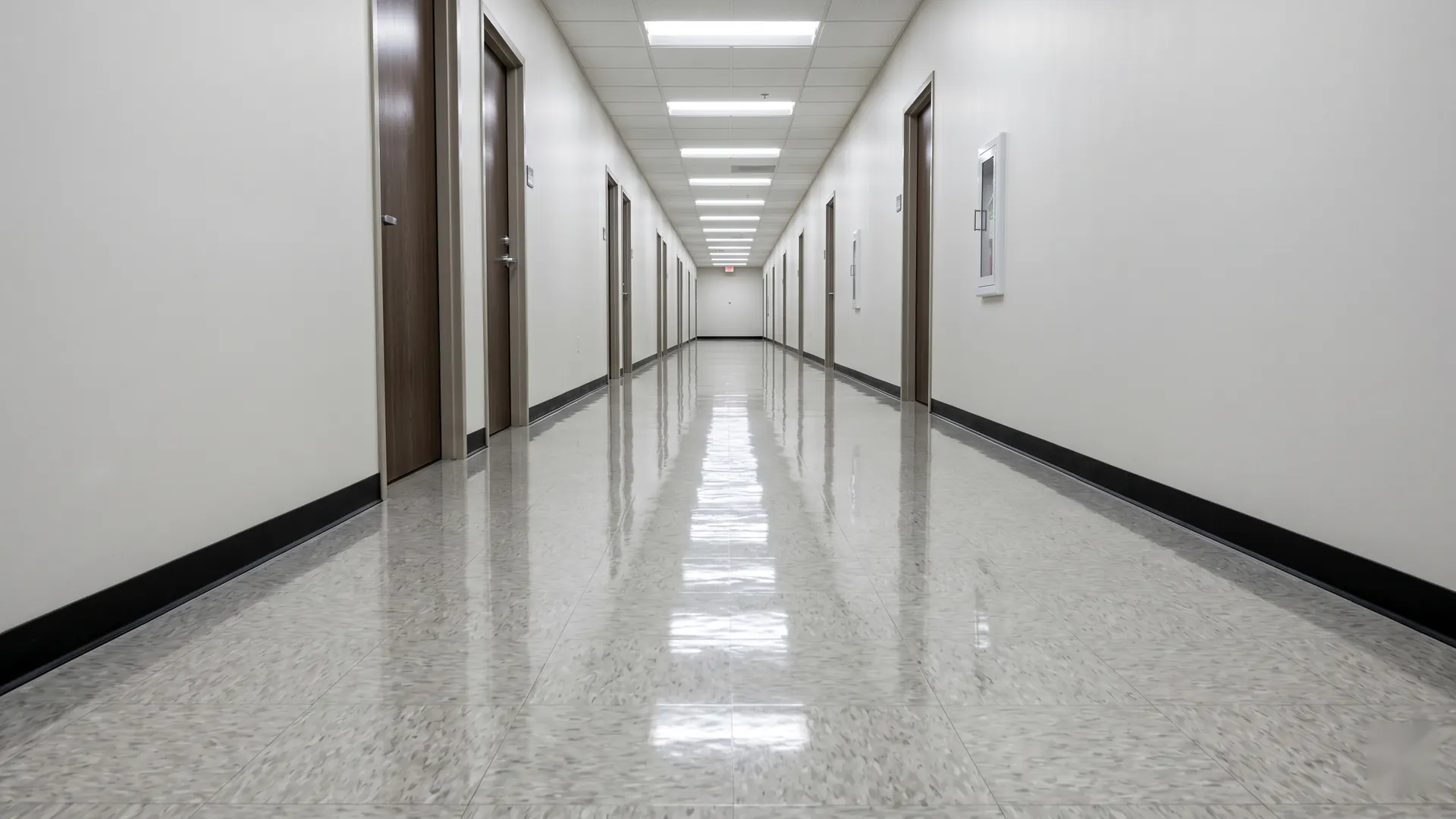
Two of the most common floor-care services on a commercial cleaning contract are “strip and wax” and “scrub and recoat.” They sound similar and they look similar from a distance, but they do different jobs at different costs. Choose the wrong one for your floor’s condition and you either spend too much (stripping a floor that just needed a recoat) or you damage the floor (recoating when a strip was overdue). Here is how to tell which one your floor actually needs.
What each service actually does
Strip and wax (the full reset)
Stripping removes every layer of floor finish down to the bare floor. A chemical stripper softens the wax, an auto-scrubber lifts it, the floor is rinsed and neutralized, and four to six fresh coats of finish are applied. The result: a brand-new wax base on a clean substrate.
Cost: highest. Time: 6-12 hours of closure including dry time. Typical frequency: annually for most commercial floors, semi-annually for high-traffic.
Scrub and recoat (the maintenance reset)
Recoating removes only the top, dirty layer of finish using a less aggressive chemistry and a softer pad. The cleaned wax surface is then re-coated with one or two fresh layers. Underneath, the original wax base stays intact.
Cost: roughly half of a strip and wax. Time: 2-4 hours of closure. Typical frequency: quarterly to semi-annually depending on traffic.
How to tell which your floor needs
Signs your floor needs a recoat (not a strip)
- The shine has dulled, particularly in walking lanes, but the wax surface is still intact.
- Light black scuffs that come up with a damp mop or burnishing.
- Edges and under-furniture areas still look glossy.
- It has been less than a year since the last strip and wax.
- The floor underneath looks healthy, no cracks or surface damage.
If most of these check, schedule a scrub and recoat. You will get back the gloss without the cost or the closure time of a full strip.
Signs your floor needs a full strip and wax
- Black scuffs that resist scrubbing — the wax is worn through and the marks are on the floor itself.
- Discolored or yellowed wax buildup, especially at edges.
- The wax has been recoated 3+ times since the last strip.
- Visible “ribbon” patterns where the auto-scrubber has been making the same passes.
- It has been a full year (or more) since the last strip.
- Areas of waxed floor look uneven, blotchy, or hazy when wet.
If most of these check, you are overdue for a strip. Recoating now will trap dirt under fresh wax and the floor will look worse in two months than it does today.
The maintenance cycle that minimizes total cost
The cheapest long-term floor care does not actually skimp on services. It uses the right service at the right time so the floor lasts decades and the strip cycles stay infrequent.
The standard rotation for moderate-to-high traffic commercial floors:
- Daily. Dust mop and damp mop with neutral pH cleaner. Cost: included in nightly janitorial.
- Weekly or biweekly. High-speed burnishing. Cost: included or modest add-on. Restores gloss without removing wax.
- Quarterly. Scrub and recoat in walking lanes and high-traffic areas. Cost: low-to-moderate.
- Semi-annually. Full-floor scrub and recoat. Cost: moderate.
- Annually. Full strip and wax. Cost: highest, but only once a year.
This rotation typically costs less per year than skipping the maintenance and doing emergency strip-and-waxes more frequently. It also keeps the floor looking consistently good rather than oscillating between freshly-stripped and overdue.
What about polished concrete, terrazzo, and natural stone?
None of those floors get traditional wax. They have entirely different maintenance cycles. Polished concrete gets re-densified and re-polished every 1-3 years. Terrazzo gets honed and resealed every 3-5 years. Natural stone (marble, granite, limestone) gets cleaned with stone-safe chemistry and resealed every 1-2 years.
If a vendor proposes “strip and wax” on any of these floor types, that is a red flag. They should be proposing the appropriate refinishing service. See our floor refinishing service for details on these specialty floors.
Common mistakes
- Stripping too often. Every strip-and-wax is hard on the floor underneath. Doing it more than 1-2 times a year shortens the floor’s life.
- Recoating an overdue floor. If the wax is worn through, a recoat traps dirt. The floor needs a strip first.
- Cheap finish. Commercial-grade wax (18-25% solids) lasts twice as long as the budget product. The cost difference is small.
- Skipping daily mopping. Grit is the #1 enemy of wax. One missed nightly clean adds wear that no recoat can fix.
- Wrong cleaner pH. Using a high-pH cleaner on waxed floors slowly strips the wax, defeating the maintenance cycle.
Frequently Asked Questions
How much does a strip and wax cost vs a scrub and recoat?
Strip and wax typically runs $0.30-$0.80 per square foot for commercial floors, depending on size, soiling, and finish coats. Scrub and recoat runs roughly half that. Pricing is highly facility-specific; get a written quote based on a walk.
How long does the floor have to stay closed for each?
Strip and wax: 6-12 hours of closure including dry time, typically scheduled overnight on a Friday so the floor cures by Monday. Scrub and recoat: 2-4 hours, often scheduled overnight on a weekday.
Can the same crew do both?
Yes. The skill set, equipment, and chemistry overlap. Most commercial cleaning vendors with a floor-care specialty can handle both. Strip and wax requires more equipment (auto-scrubber, wet/dry vac, pump-up sprayer for stripper) and dedicated drying time.
How do I know if my floor was waxed correctly the first time?
A correctly-waxed floor has 4-6 coats of finish, applied with even drying time between coats, on a fully clean substrate. Signs of a bad wax: streaks visible after drying, premature wear in lanes, yellowing at edges, areas that feel “tacky” months later, or thin coverage that wears through within months.
Should the wax be food-service grade in restaurant front-of-house?
Yes. Food-service-rated finishes are slip-resistant when wet, oil and grease resistant, and certified for incidental food contact. Standard commercial wax is fine in offices but not in restaurants, kitchens, or food prep zones. See our restaurant cleaning service.
Need a floor-care plan for your facility?
E & J Cleaning has been keeping Long Island commercial floors looking new for two decades. See our floor waxing service, floor refinishing service, or request a free site walk. Call 1-877-443-2635.