
Bank and Financial Office Cleaning: Quiet Hours and Confidential Spaces

Bank branches and financial offices have cleaning requirements other commercial spaces do not face. The crew is alone in the building at night with access to vault rooms, ATM service areas, customer files, computer terminals, and confidential documents. Bonding and background screening are not optional. Cleaning protocols around safe deposit areas, dual-control procedures, and after-hours alarm coordination shape what is possible. None of this changes what counts as a clean branch; it changes who can do the work and how.
This guide is for facility managers, branch managers, and regional operations leads at Long Island banks, credit unions, financial advisor offices, and investment firms evaluating cleaning vendors or refining current programs.
What is different about financial office cleaning
Several specific factors:
Background screening intensity. Most banks require fingerprint-based background checks on every individual cleaning the branch. Standard commercial background checks are often insufficient. The cleaning company has to be willing and able to put crew through bank-grade screening.
Bonding levels. Standard $25,000 janitorial bond is the floor. Many banks require $50,000-$100,000 or higher. Some require specific dishonesty bond endorsements naming the financial institution.
Confidentiality language. Contract includes non-disclosure provisions covering anything cleaners might observe (customer documents on desks, account information on screens, sensitive communications). Crew training on confidentiality is documented.
After-hours access protocols. Branches with vault timers, alarm systems with limited bypass windows, dual-key procedures for certain areas. Cleaning has to work around these rather than against them.
Camera awareness. Most branches have continuous camera coverage. Crew works knowing they are recorded. Some banks review cleaning crew footage routinely.
Visible-only scope in restricted areas. Vault rooms, safe deposit box areas, and certain back-office zones may be cleaned only when an authorized employee is present, or scope may be limited to specific surfaces while doors remain locked.
ATM and night-deposit handling. Cleaning around these areas requires specific protocols. Touching cash-handling equipment is rarely in scope.
The zones in a typical bank branch
Most Long Island bank branches break down into:
- Public lobby. Teller line area, customer waiting, deposit slips and forms, ATM lobby. Highest customer visibility.
- Customer-facing offices. Banker offices for account opening, loan officer offices, wealth management offices. Customer visits, but lower volume than the teller line.
- Teller workstations (behind the line). Cleaning the floor and surfaces around teller stations without touching teller-controlled materials.
- Back-office. Operations area, manager office, file storage, break room.
- Vault and safe deposit box area. Most restricted. Cleaning typically minimal or only with authorized employee present.
- Restrooms. Customer-facing and employee-only restrooms. Standard high-grade commercial restroom cleaning.
- Drive-through area (if present). Outdoor cleaning of customer-facing surfaces.
Cleaning frequency and scope vary by zone. Public lobby gets daily attention; vault area may be weekly or only when accessible.
Public lobby standards
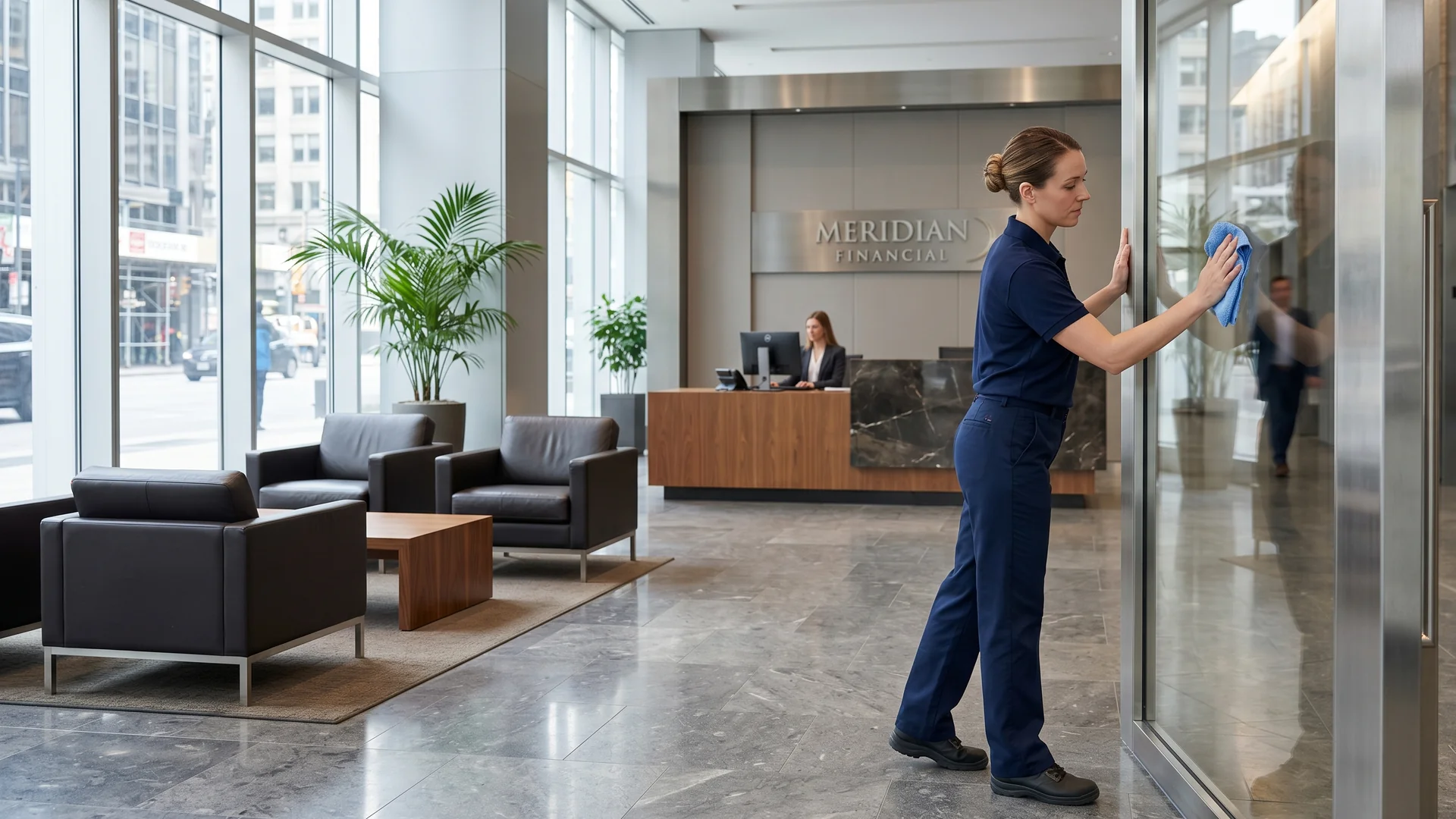
The branch lobby is the daily customer experience. What needs to look right every morning:
- Teller line counter wiped and polished
- Customer-facing glass (entry doors, ATM enclosure glass, vault display glass) polished
- Floor swept, mopped, and any spots addressed
- Customer waiting area (chairs, tables) cleaned and reset
- Deposit slip and form area refreshed (supplies stocked, debris cleared)
- ATM area cleaned (floor, glass, exterior of machine; not the cash handling components)
- Trash and recycling pulled
- Restroom (if customer-accessible) detailed
- Branch entry mat refreshed (heavy traffic on lobby mats)
This is typically a 30-90 minute pass depending on branch size, run after close (5 PM or 6 PM start) or before open (4 AM or 5 AM start).
After-hours access logistics
The operational challenge specific to banks: the cleaning crew has to enter the building, complete work, and exit, all within specific alarm and access windows. Coordination items:
- Alarm bypass coordination. Crew has their own alarm code or there is a dedicated bypass window. Coordinated with the branch’s central monitoring.
- Key control. Keys held in dual control or under specific check-out protocols. Loss of a key triggers re-keying of the branch.
- Vault timer awareness. Vault doors are timed; cleaning cannot interfere with the lock window.
- Cash handling area. Many branches lock down cash drawers and ATM cassettes when the cleaning window opens. Crew never has access to cash.
- Emergency procedures. If the cleaning crew triggers an alarm or notices something amiss, specific contact procedures for the bank’s loss prevention or security.
- Time logging. Crew arrival and departure logged to central monitoring. Reviews against camera footage if anomalies arise.
These protocols are not optional and they are not unusual. They are the operational backbone of bank cleaning. A cleaning company without experience operating in this environment will struggle.
Specific to financial advisor and investment offices
Independent financial advisor offices, RIA firms, and investment offices have similar but slightly different requirements:
- Less alarm and vault complexity than retail banking
- Higher concentration of confidential client documents (account statements, financial plans, signed agreements) on desks and in unlocked file areas
- Higher emphasis on client confidentiality (advisor-client privilege concerns)
- SEC/FINRA compliance documentation may need cleaning vendor records (background checks, training documentation, COIs)
- Trading floors (if present) need specific schedule coordination to avoid disrupting market-hours operations
Cleaning approach is similar to bank: confidentiality language, background screening, careful scope around customer-facing areas.
What to ask cleaning companies bidding on bank work
- Have you cleaned bank branches, credit unions, or financial offices before on Long Island?
- Are your crews willing and able to complete fingerprint-based background checks?
- What is your bonding level, and can you provide a $100,000 bond with the bank named as obligee if required?
- Do you have non-disclosure agreement language in your standard contract?
- How do you handle alarm code and key control?
- Do you have W-2 employees only, or any subcontracted crew? (Banks generally do not accept subcontracted crew on financial premises.)
- Can you produce certificates of insurance naming the bank as additional insured?
- Have you ever had a loss or incident at a bank or financial office account?
Pricing context
Bank and financial office cleaning runs a premium over standard commercial cleaning, driven by:
- Background screening cost (annual, per cleaner)
- Higher bonding levels (premium for $100K+ bonds)
- Specialized confidentiality and compliance documentation
- Dedicated rather than rotating crew (banks usually want the same cleaners assigned)
- Compressed cleaning windows (smaller after-hours window than office)
- Lower scope flexibility (specific areas off-limits or restricted)
Typical premium is 15-25% over a comparable-size general office cleaning contract. Banks that try to procure cleaning at general-office pricing usually end up with subcontracted crew that fails the screening test or service that does not meet the contract’s compliance language.
What good bank cleaning looks like at the branch level
Branch managers who have good cleaning relationships tend to report:
- Same crew every visit (rather than rotating strangers)
- Same time window (predictable arrival and departure)
- Crew leadership who answers the phone same day if an issue arises
- Visible accountability log (sign-in sheet or app entry showing exactly who was in the branch)
- No customer or employee complaints about cleaning
- Easy COI and screening documentation when corporate audit asks
- Calm coordination during branch events (renovations, equipment installations, audit visits)
The cleaning relationship at a bank should feel boring. Reliable, undramatic, well-documented. When it gets exciting, something is going wrong.
E & J Cleaning works with Long Island bank branches and financial offices on cleaning programs that meet bank-grade background screening, bonding, and compliance requirements. Dedicated W-2 crew, NDA and confidentiality language, alarm and key control protocols. Visit our bank cleaning page or call 1-877-443-2635 for a confidential discussion.
Frequently Asked Questions
What background checks should bank cleaning crews complete?
Most banks require fingerprint-based background checks, not just standard commercial. Standard $25K janitorial bond is the floor; many banks require $50-100K with the bank named as obligee.
Can subcontracted cleaning crews work at bank branches?
Generally not. Banks typically require W-2 employees of the cleaning company to ensure background screening and accountability. Subcontracted crews create gaps in screening and supervision banks usually will not accept.
How is bank cleaning priced versus general office?
Typically 15-25% premium over comparable general office. Driven by background screening cost, higher bonding, compliance documentation, dedicated rather than rotating crew, and compressed after-hours windows.
What happens if a bank cleaning crew triggers an alarm?
Crew follows pre-established contact procedures with the bank’s loss prevention or central monitoring. Camera footage is reviewed against time logs. Repeat incidents are grounds for crew removal.
Bank Branch Cleaning That Meets Compliance?
Free walk. W-2 crew. Confidentiality clauses.